
Swiss Cheese plant (Monstera deliciosa)
Monstera deliciosa is an evergreen perennial large climbing vine that can climb trees or other supports with aerial roots and may grow terrestrially, semi-epiphytically, or epiphytically.
Watch: Monstera vs Philodendron vs Alocasia vs Anthurium
Overview
Monstera deliciosa is an evergreen perennial large climbing vine that can climb trees or other supports with aerial roots and may grow terrestrially, semi-epiphytically, or epiphytically.
Origin and habitat
It is native from Mexico through Central America, mainly including southern Mexico and Guatemala and extending south to Costa Rica and Panama, although sources differ on the northern and southern limits of its native range. It occurs in humid tropical forests and rainforests, where it may grow on the ground or climb trees; it has also been recorded in humid montane forest. It favors warm, humid tropical to subtropical conditions and is also widely grown as an indoor foliage plant in temperate regions.
Characteristics
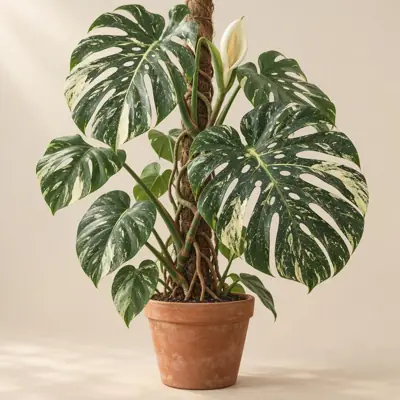
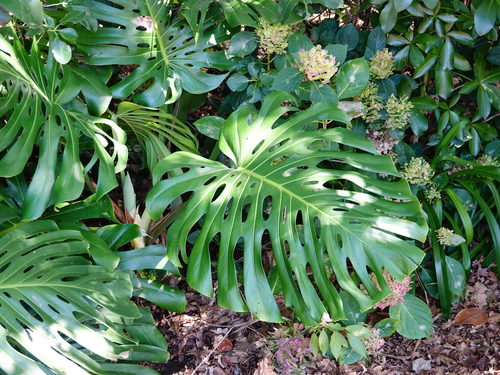
Sources differ on mature height, with reported values of about 400–800 cm; few sources give mature spread, reported at about 150–250 cm. Sources differ on growth rate, describing it as slower than to moderate relative to ordinary green Monstera deliciosa, with reduced chlorophyll in variegated tissue lowering overall growth rate. The large, thick, leathery to waxy leaves are often heart-shaped; juvenile leaves are usually entire and lack holes, while mature leaves progressively develop perforations between the veins and deep splits, with long petioles and conspicuous aerial roots arising from stem nodes. The inflorescence is a typical aroid spadix surrounded by a roughly white, cream-white, or yellow-white spathe, with a pale yellow to yellow-white spadix; sources differ on flowering season, describing flowering from spring and summer into autumn and as more likely during warm periods, while the fruit is a green cylindrical to conical aggregate fruit resembling an ear of corn and covered with polygonal scales.
Light
Sources differ on light conditions: bright indirect light to partial sun or partial shade is described as suitable, and the plant tolerates shade, although prolonged low light may cause elongated internodes and weaker growth; some sources report adaptation to full sun while others recommend avoiding direct sunlight, and variegated forms generally need more light than green forms. It is generally reported to favor bright indirect light.
Watering
Water thoroughly during active growth after the surface of the growing medium has dried, avoid prolonged waterlogging, and keep moisture management lighter in winter. A watering interval of about 7–10 is reported by few sources.
Humidity and airflow
It prefers high humidity, with few sources reporting about 40–60 % humidity. It is generally reported to need moderate airflow.
Temperature and dormancy
Sources differ on the lower temperature guidance, with a value around 18 °C reported. Few sources report an upper temperature value around 38 °C. It is generally reported to tolerate brief light frost.
Growing medium and mounting
Use an organic-rich, well-drained medium with good root-zone aeration; bark or perlite can be added to increase pore space. It is generally reported to favor an airy mix.
Feeding
Feed regularly during active growth; sources differ on fertilizer formulation and application schedule, including balanced liquid, slow-release, and long-lasting complete fertilizers.
Propagation
It can be propagated by stem cuttings, layering, or air layering, and stem sections with nodes can root and produce new growth.
Common problems
Possible pests include spider mites, mealybugs, aphids, and scale insects. Root rot, leaf spot, and damping-off may occur, and excessive moisture combined with poor ventilation can increase the risk of some diseases. Low light combined with frequent watering, overly dense growing medium, or an oversized container may lead to poor root-zone aeration, stalled growth, smaller leaves, and root problems; cream-white patches are also more prone to browning, while transport and abrupt environmental changes may damage leaves. It is sensitive to frost and low temperatures and has weak cold tolerance; some mature plants may withstand brief near-freezing conditions, but growth may stop or survival become difficult under sufficiently cold conditions.
Identification
Key identifying features are large mature leaves bearing both deep splits and natural perforations together with well-developed aerial roots at stem nodes; juvenile leaves are usually entire and lack holes, with leaf form changing markedly as the plant matures.
Photos


Sources
- GBIF Backbone: Monstera deliciosa Liebm. — CC BY 4.0 · link
- Wikipedia (en): Monstera deliciosa — CC BY-SA 4.0 · link
- 維基百科:龟背竹 — CC BY-SA 4.0 · link
- Wikipedia (ja): ホウライショウ — CC BY-SA 4.0 · link
- Wikipedia (de): Köstliches Fensterblatt — CC BY-SA 4.0 · link
- Wikipedia (fr): Faux philodendron — CC BY-SA 4.0 · link
- Wikipedia (es): Monstera deliciosa — CC BY-SA 4.0 · link
- GBIF descriptions: Arbolado urbano de Bogotá D.C asociado a servicios ambientales y culturales valorados como base de l — per dataset · link
- NC State Plant Toolbox: Monstera deliciosa — copyright (facts only) · link
- Wikipedia (it): Monstera deliciosa — CC BY-SA 4.0 · link
- Wikipedia (nl): Gatenplant — CC BY-SA 4.0 · link
- Wikipedia (pt): Costela-de-adão — CC BY-SA 4.0 · link
- TaiCOL 臺灣物種名錄: Monstera deliciosa — CC BY 4.0 · link
- 農業知識入口網 植物圖鑑: Monstera deliciosa — © MOA, facts only · link