
Swiss Cheese plant (Monstera deliciosa)
Monstera deliciosa is an evergreen perennial climbing vine that can attach to tree trunks or other supports with aerial roots and is also described as semi-epiphytic or a wandering vine.
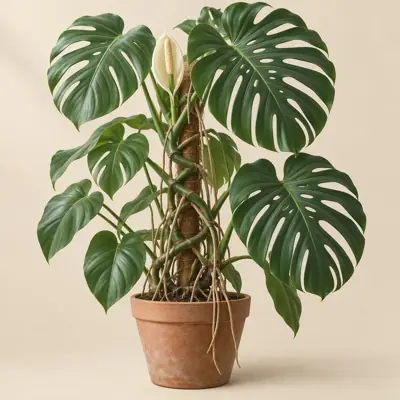
Watch: Monstera vs Philodendron vs Alocasia vs Anthurium
Overview
Monstera deliciosa is an evergreen perennial climbing vine that can attach to tree trunks or other supports with aerial roots and is also described as semi-epiphytic or a wandering vine.
Origin and habitat
Sources differ on its native range, describing southern Mexico and Central America extending south to Panama. It inhabits humid tropical forests, beginning as a terrestrial juvenile that can climb trees and later developing a semi-epiphytic or climbing habit; it is also recorded from humid montane forests. It prefers warm, humid tropical to subtropical environments and is also widely grown indoors as a foliage plant in temperate regions.
Characteristics
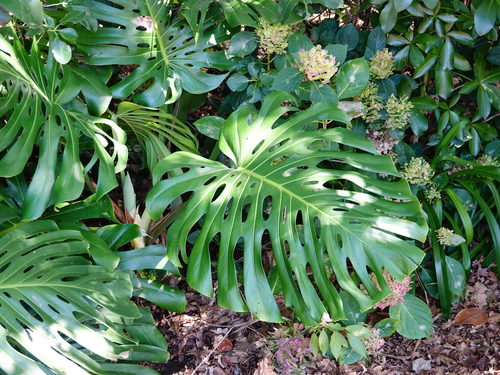
Sources differ on mature height, placing it at about 700–2100 cm, while a single source reports a mature spread of about 150–250 cm. Sources differ in describing its growth as fast; its large, thick, leathery leaves are often heart-shaped to heart-shaped-ovate, with smaller juvenile leaves usually entire and mature leaves progressively developing splits and perforations between the veins. The inflorescence is a typical aroid spadix surrounded by a spathe; the spathe is described as white, creamy white to yellowish white, and the spadix as whitish yellow to pale yellow, with flowering from spring through autumn and more likely during warm periods.
Light
Sources differ on light conditions: bright indirect light to partial sun is described as most suitable indoors, and the plant tolerates shade, while some outdoor horticultural sources report adaptation to full sun with gradual acclimation and attention to moisture. It tolerates bright indirect light.
Watering
Water thoroughly, then allow the surface of the growing medium to dry before watering again; maintain lower moisture during winter and avoid prolonged excessive wetness, while some Taiwanese sources describe a degree of drought tolerance.
Humidity and airflow
It prefers high humidity and is generally reported to need good airflow.
Temperature and dormancy
The ideal temperature is 20–30 °C. Sources differ on the lower temperature figure, with limited evidence placing it at about 10 °C, while a single source reports an upper figure of about 38 °C. A single source gives a hardiness-zone classification and generally reports that it tolerates brief light frost.
Growing medium and mounting
It grows in well-drained, fertile, organic-rich loamy medium; indoors, a well-drained and well-aerated potting medium can be used. It has aerial and soil roots and grows in an airy mix.
Feeding
Sources differ on feeding schedules, but describe regular fertilizing during the growing season with liquid, slow-release, or long-lasting complete fertilizer.
Propagation
It can be propagated by stem cuttings, layering, or air layering, and some sources also record propagation by division.
Common problems
Potential pests include scale insects and spider mites, with NC State additionally listing fern scale. Problems including damping-off are generally reported, with risk increasing under excessively wet conditions in spring and autumn. Prolonged insufficient light may cause elongated internodes, weak growth, and poor development of perforations or splits in mature leaves; overly strong direct light or sudden changes in light may damage leaves, while large, heavy stems and leaves may topple or break without support. It is sensitive to frost and low temperatures; growth may stop or survival become difficult in sufficiently cold conditions, frost can be fatal, and some information on mature plants reports brief tolerance of mild freezing but does not present this as a generally safe growing condition.
Identification
Distinctive features include mature large leaves with both deep splits and natural perforations, along with well-developed aerial roots emerging from stem nodes; leaves progress from an entire juvenile form to perforated and deeply split forms.
Photos


Sources
- GBIF Backbone: Monstera deliciosa Liebm. — CC BY 4.0 · link
- Wikipedia (en): Monstera deliciosa — CC BY-SA 4.0 · link
- 維基百科:龟背竹 — CC BY-SA 4.0 · link
- GBIF descriptions: Arbolado urbano de Bogotá D.C asociado a servicios ambientales y culturales valorados como base de l — per dataset · link
- NC State Plant Toolbox: Monstera deliciosa — copyright (facts only) · link
- Wikipedia (ja): ホウライショウ — CC BY-SA 4.0 · link
- Wikipedia (de): Köstliches Fensterblatt — CC BY-SA 4.0 · link
- Wikipedia (fr): Faux philodendron — CC BY-SA 4.0 · link
- Wikipedia (es): Monstera deliciosa — CC BY-SA 4.0 · link
- Wikipedia (it): Monstera deliciosa — CC BY-SA 4.0 · link
- Wikipedia (nl): Gatenplant — CC BY-SA 4.0 · link
- Wikipedia (pt): Costela-de-adão — CC BY-SA 4.0 · link
- 農業知識入口網 植物圖鑑: Monstera deliciosa — © MOA, facts only · link
- Useful Tropical/Temperate Plants: Monstera deliciosa — CC BY-NC-SA 3.0 (facts only) · link