
Adanson's monstera (Monstera adansonii)
Monstera adansonii is a perennial evergreen climbing herbaceous vine that can climb or trail, has epiphytic or semi-epiphytic habits, and produces aerial roots.
Watch: Monstera vs Philodendron vs Alocasia vs Anthurium
Overview
Monstera adansonii is a perennial evergreen climbing herbaceous vine that can climb or trail, has epiphytic or semi-epiphytic habits, and produces aerial roots.
Origin and habitat
Sources differ on its native range, describing it across tropical America from Mexico and Central America into parts of South America and on Caribbean islands including the Lesser Antilles, while Puerto Rico is recorded as introduced. It grows mainly in moist tropical forests and dense rainforests, where it can grow epiphytically and climb tree trunks, and it is also common in low-elevation river valleys. It occurs in tropical to warm, humid environments and prefers warm conditions with high humidity.
Characteristics
Sources differ, but mature height is reported at about 200–400 cm; sources are few for mature spread, which is reported at about 50–100 cm. Sources differ in their descriptions of the leaves, which are green, somewhat thick to nearly leathery and sometimes glossy, ranging from broadly ovate or heart-shaped to elliptic, usually with entire margins and elliptic holes of varying sizes. Bisexual flowers are densely arranged on a cylindrical, creamy white to yellow spadix surrounded by a creamy white to pale yellow spathe. It is reported to grow quickly, and its fruiting spadix changes from green to yellow or deep yellow, with berries generally containing a single brown or black seed.
Light
Monstera adansonii does well in bright indirect light to partial shade, while prolonged strong direct sunlight should be avoided. It may survive in lower light, but its growth can slow.
Watering
Keep the growing medium slightly moist without waterlogging and ensure good drainage; water more generously during the growing season and reduce watering in winter. Sources are few and report a summer watering interval of about 7 and a winter interval of about 14–21.
Humidity and airflow
Monstera adansonii prefers high humidity.
Temperature and dormancy
Sources differ, but a minimum temperature of about 15 °C is reported. Sources differ on the reported hardiness zone. It tolerates brief light frost.
Growing medium and mounting
It prefers a light, moist but well-drained growing medium; loam-based potting medium can be used, and horticultural sources describe acidic, neutral, and alkaline conditions as acceptable. It has aerial and soil roots and prefers an airy mix.
Feeding
It is reported to benefit from regular applications of a balanced liquid fertilizer during the growing season.
Propagation
It can be propagated by seed, cuttings, or layering, with horticultural sources also specifically recording propagation from cuttings.
Common problems
Scale insects, including fern scale insect, are reported pests. Prolonged direct sunlight can scorch or dry the leaves, excessive waterlogging can cause root rot, and lack of climbing support can result in smaller leaves. It prefers warm conditions and should be protected from cold drafts and excessively low temperatures; sources differ on its tolerance of short periods of low temperature or light frost.
Identification
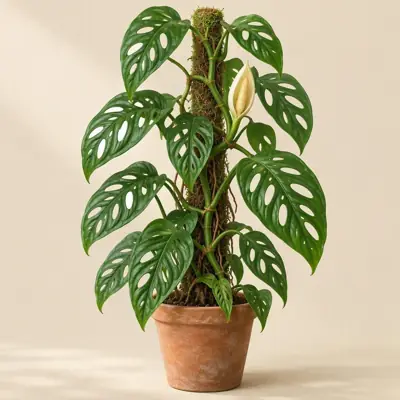
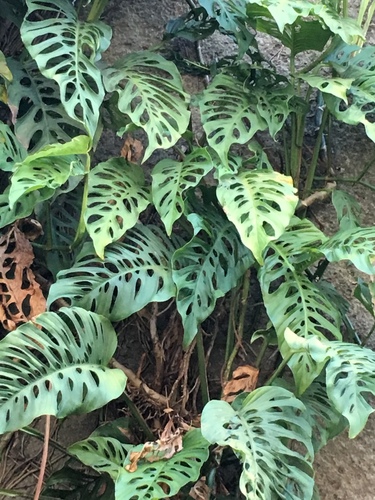
Its most conspicuous features are multiple elliptic perforations within entire leaf margins and aerial roots that attach to supports; compared with Monstera deliciosa, the plant and its leaves are smaller.
Photos


Sources
- GBIF Backbone: Monstera adansonii Schott — CC BY 4.0 · link
- Wikipedia (en): Monstera adansonii — CC BY-SA 4.0 · link
- Wikipedia (ja): マドカズラ — CC BY-SA 4.0 · link
- Wikipedia (fr): Monstera adansonii — CC BY-SA 4.0 · link
- GBIF descriptions: Catálogo de Plantas y Líquenes de Colombia; Plantas vasculares que se han reportado en los bosques s — per dataset · link
- NC State Plant Toolbox: Monstera adansonii — copyright (facts only) · link
- Wikipedia (it): Monstera adansonii — CC BY-SA 4.0 · link
- Wikipedia (nl): Rimpelgatenplant — CC BY-SA 4.0 · link
- Wikipedia (pt): Monstera adansonii — CC BY-SA 4.0 · link
- Useful Tropical/Temperate Plants: Monstera adansonii — CC BY-NC-SA 3.0 (facts only) · link
- RHS Plants: Monstera adansonii — © RHS, facts only · link
- USDA PLANTS Database: Monstera adansonii — Public domain (US Government work) · link
- Top Tropicals catalog: Monstera adansonii — © Top Tropicals LLC (facts only) · link