
Dwarf Bushcandle (Monsonia patersonii)
Monsonia patersonii is a spiny, upright to obliquely spreading succulent shrub or small shrub with fleshy stems. It is reported to be perennial.
Overview
Monsonia patersonii is a spiny, upright to obliquely spreading succulent shrub or small shrub with fleshy stems. It is reported to be perennial.
Origin and habitat
It is native to Namibia, from the Rosh Pinah area to Lüderitz, and to the coastal Richtersveld of South Africa's Northern Cape. It is reported from dry habitats ranging from the coast to several kilometres inland, including windblown sand, shallow rocky soil on dune crests, and fissures in igneous rock. Its environment is hot and arid with intense sunlight.
Characteristics
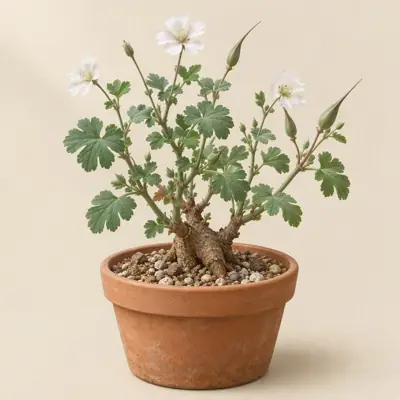
Few sources report a mature height of about 0–50 cm. It is reported to be deciduous, with hairless, blunt-tipped, entire leaves that are oblong-wedge-shaped or narrowly to broadly obovate; the leaves are nearly stalkless or have short petioles that can gradually become spines. The solitary bisexual flowers have rose, pale magenta to purple petals; another source has observed small pink flowers. It is reported to have beaked fruit and a tuber, and mature plants are generally upright to spreading-ascending succulent shrubs or small shrubs.
Light
During vigorous growth it needs intense light and direct sun; filtered light can be used during the hottest period when it is dormant.
Watering
Sources differ on watering details: water regularly during active growth and while leaves are present, stop watering when the leaves begin to yellow or wilt, and provide only a little or occasional water during dormancy to avoid excessive dehydration while avoiding overwatering. It is generally recommended to keep it evenly moist while in leaf and to water sparingly while leafless. Few sources report a summer watering interval of about 6–10.
Temperature and dormancy
Few sources report a minimum of about 8 °C. It is reported to drop its leaves and go dormant, with dormancy triggered by heat. It is reported to have high heat tolerance.
Growing medium and mounting
It is reported to need a very fast-draining, mineral-rich growing medium.
Propagation
Propagation by seed is reported to be more reliable; seeds are sown shallowly below the soil surface and later moved to individual containers. Cuttings are reported to perform poorly in general, and plants raised from cuttings often branch poorly.
Common problems
Overwatering is reported to be an important cultivation problem to avoid; plants transplanted from the wild often struggle to re-establish extensive root systems and flower only sporadically. Its native environment includes strong wind, blowing sand, intense sunlight, and drought, and its thick waxy bark provides protection from windblown sand. In cultivation it may become dormant during the hottest period.
Identification
Distinguishing features include a woody tuberous root, long-lived fleshy coarse rigid branches, conspicuous spines, wedge-shaped leaves, and thick waxy bark. The waxy bark resists windblown sand and is flammable.