
Redthroat Bushcandle (Monsonia multifida)
Monsonia multifida is reported to be a semi-erect, small shrubby succulent with a fleshy, knobby stem and an enlarged main root. It is reported to be a perennial, long-lived plant.
Overview
Monsonia multifida is reported to be a semi-erect, small shrubby succulent with a fleshy, knobby stem and an enlarged main root. It is reported to be a perennial, long-lived plant.
Origin and habitat
It is reported to be native and restricted to a small area on both sides of the Orange River mouth, including Namibia and the Richtersveld in South Africa's Northern Cape. It is reported from the Lower Orange River Zone, in dry, exposed gravel flats, nearly pure rocky substrates that are usually shale, and dune environments. Its habitat is hot, arid, and strongly sunlit.
Characteristics
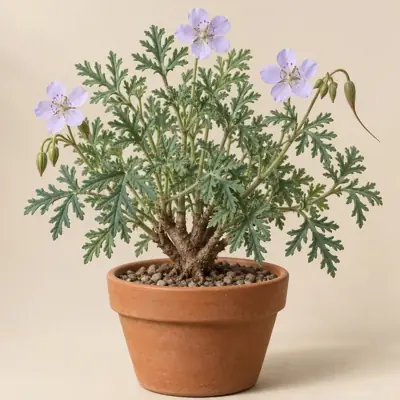
Few sources report a mature height of about 0–20 cm and a spread of about 0–25 cm. It is reported to grow slowly and to have a swollen root. The leaves are reported to be grayish, hairy, deciduous, and long-stalked, with broadly ovate to nearly round, deeply divided blades that are often arranged along the upper sides of horizontal branches. The flowers are reported to be bisexual and solitary, with white, pink, or magenta petals that often have dark red to scarlet markings at the base, while some flowers may be entirely white; the fruit has an elongated basal portion and tail, and contains seeds.
Light
During vigorous growth it needs direct sun and prolonged strong light, while filtered light is recommended during the hottest dormant period.
Watering
During active growth and while leaves are present, water regularly, avoid overwatering, and maintain good airflow; stop watering when the leaves begin to yellow or wilt. During dormancy, provide only a little water and water sparingly while leafless; sources also note that year-round watering in cultivation may be used in an attempt to avoid dormancy. Sources differ on the summer watering interval, giving a range of about 6–10.
Temperature and dormancy
Few sources report a minimum temperature of about 8 °C. It is reported to drop its leaves and go dormant, with dormancy triggered by heat. It is reported to have high heat tolerance.
Growing medium and mounting
It is reported to need a very fast-draining mix dominated by mineral materials such as pumice and volcanic gravel.
Propagation
Propagation from seed is reported to be easy, with seeds covered shallowly and seedlings later moved into separate containers. Cuttings are reported to perform poorly in general and often produce little branching.
Common problems
Overwatering is reported to be unfavorable in cultivation. Wild populations are reported to be sensitive to continuing habitat degradation because growth is slow and recruitment of new individuals is limited. During the hottest part of summer, prolonged exposure to the strongest direct light is best avoided and filtered light can be used; in winter, temperatures are recommended not to fall too low.
Identification
It is reported to have an enlarged main root and a knobby, fleshy, tuber-like main stem, with short, thick branches that often spread horizontally and are usually spineless but may occasionally bear blunt spines. Its grayish leaves are finely divided and hairy, and the flowers often have conspicuous dark red to scarlet markings at the base.
Photos

