
Microsorium pteropus (Microsorum pteropus)
Microsorum pteropus is reported to be an aquatic to semi-aquatic epiphytic fern that can grow fully or partly submerged or in moist waterside environments, with its rhizome attached to surfaces such as rocks, driftwood, or riverbank roots.
Overview
Microsorum pteropus is reported to be an aquatic to semi-aquatic epiphytic fern that can grow fully or partly submerged or in moist waterside environments, with its rhizome attached to surfaces such as rocks, driftwood, or riverbank roots.
Origin and habitat
Microsorum pteropus is native to Southeast Asia and neighboring regions, with sources specifically recording Malaysia, Thailand, northeastern India, southern China, Ishigaki and Iriomote in Japan's southwestern islands, and native populations in Taiwan. Its natural habitat is reported to consist mainly of tropical and subtropical rivers and riverbanks, where it attaches to moist rock faces, rocks, or riverbank roots and can live underwater, at the water's edge, or partly submerged, while its roots and rhizome remain moist. It is reported from moist tropical to subtropical riverbank environments, while a Japanese source also places native habitat in relatively cool upper reaches of rivers.
Characteristics
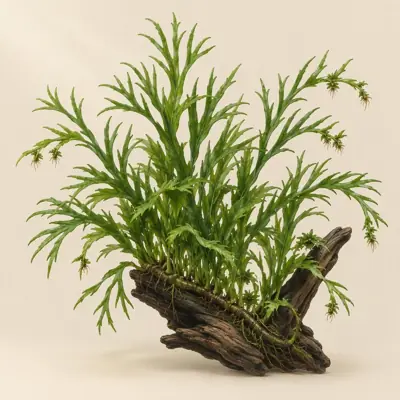
Growth is reported to be slow to moderately slow. The leaves of 'Trident' are reported to branch repeatedly, producing a finger-like or branched appearance, with a width close to needle-leaf forms; leaves of the species are generally rather firm in texture and highly variable in shape.
Light
Sources describe light requirements differently: Microsorum pteropus is described as adaptable from dim to bright aquarium conditions, while another source recommends stronger light.
Watering
The rhizome and roots are reported to need to remain moist, while aquarium-grown plants can be fully submerged. It is also reported to adapt to tap water, including hard-water or brackish-water conditions.
Temperature and dormancy
With few sources, the reported ideal temperature is about 22–28 °C.
Growing medium and mounting
The rhizome is generally not buried in sand or substrate; securing it to rocks, driftwood, or other hard aquascaping surfaces is reported to better suit its epiphytic habit.
Propagation
Microsorum pteropus is reported to propagate through adventitious plantlets produced at the tips or margins of mature leaves, as well as by dividing the rhizome. A source also recommends retaining multiple leaves on each divided rhizome section.
Common problems
A source reports that root rot and diseases associated with aquatic ferns may occur. Burying the rhizome in substrate may cause rot, while persistently high water temperatures may cause leaves to blacken and melt; poor growing conditions may also result in smaller leaves or black spots. The plant is reported to be intolerant of drying, and terrestrial cultivation especially requires moist roots and higher air humidity; persistently high water temperatures may cause blackening and melting.
Identification
The main reported identifying feature is narrow leaves that repeatedly branch outward into a trident-like to many-fingered outline; it is a 'Trident' cultivated form of Java fern.
Photos

