
Microsorium pteropus (Microsorum pteropus)
Microsorum pteropus is reported to be an aquatic to semi-aquatic epiphytic fern that can grow fully or partly submerged or along humid shorelines, with its rhizome attached to surfaces such as rocks, tree roots, or driftwood.
Overview
Microsorum pteropus is reported to be an aquatic to semi-aquatic epiphytic fern that can grow fully or partly submerged or along humid shorelines, with its rhizome attached to surfaces such as rocks, tree roots, or driftwood.
Origin and habitat
Microsorum pteropus is reported to be native mainly to Southeast Asia, with records also from Malaysia, Thailand, northeastern India, southern China, and the southwestern islands of Japan; Taiwan's species checklist treats its populations in Taiwan as native but not endemic. Its natural habitat is reported to be mainly rivers and shorelines, where it can attach to tree roots, rocks, or rock faces and grow either in water or above the surface, while its roots and rhizome remain moist. It is reported from humid tropical to subtropical river environments, while a Japanese source also describes relatively cool upstream river habitats within its native environment.
Characteristics
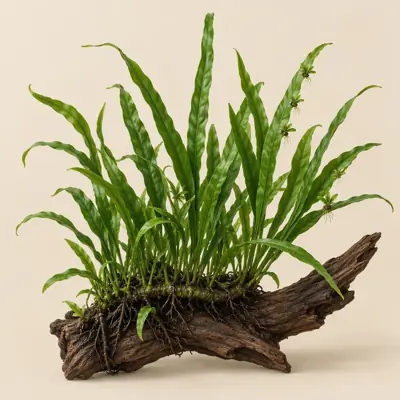
Growth is reported to be slow to moderately slow. The “Narrow” or “narrow leaf” form is reported to have narrower, denser leaves than the typical form.
Watering
The roots and rhizome are generally kept continuously moist; the plant can be grown submerged or above water where its roots have access to water and air humidity is high. In an aquarium, the rhizome generally should not be buried in the substrate.
Growing medium and mounting
The rhizome generally is not buried in ordinary soil or aquarium substrate; instead, the rhizome and roots can be secured to rocks, driftwood, or other hard aquascaping surfaces so they can attach themselves.
Common problems
The rhizome may rot if buried in the substrate, and conditions that are too dry are reported to be unsuitable for growing the plant above water. Sustained high water temperatures are reported to cause leaf blackening and melting. The plant is reported to be intolerant of dry conditions, and above-water cultivation requires relatively high air humidity. A French source reports that iron deficiency may be associated with smaller leaves and black spots.
Identification
The main reported identifying feature is narrower leaves than the typical form. The name “Narrow Leaf” may encompass more than one narrow-leaved form, so leaf shape and size can vary among plants in circulation.
Photos

