
Microsorium pteropus (Microsorum pteropus)
Microsorum pteropus is reported to be an aquatic to semi-aquatic epiphytic fern that can grow fully submerged, partly submerged, or above water in humid conditions, with its rhizome attaching to surfaces such as rocks, driftwood, and riverbank roots.
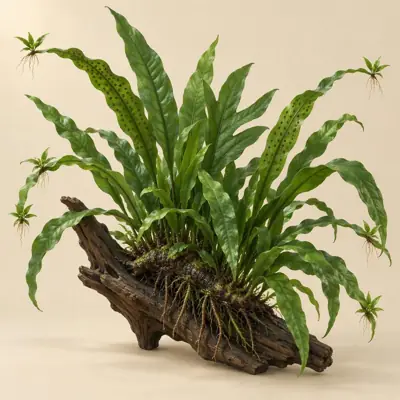
Overview
Microsorum pteropus is reported to be an aquatic to semi-aquatic epiphytic fern that can grow fully submerged, partly submerged, or above water in humid conditions, with its rhizome attaching to surfaces such as rocks, driftwood, and riverbank roots.
Origin and habitat
Microsorum pteropus is native mainly to Southeast Asia, with records also identifying Malaysia, Thailand, northeastern India, southern China, limited areas of Japan's southwestern islands including Ishigaki and Iriomote, and native populations in Taiwan. Its natural habitat is reported to consist mainly of tropical and subtropical rivers and riverbanks, where it grows attached to rock faces, rocks, or riverbank roots either in water or along the bank, with the roots and rhizome remaining moist. It is reported from humid tropical to subtropical riverbank environments, while a Japanese source reports that it can occur in cooler upper reaches of rivers within its native habitat.
Characteristics
Reported mature height is about 0–40 cm, although sources are few. Growth is reported to be slow to moderately slow. Leaves are generally undivided but may also be three-lobed; the typical form is reported to have firm leaves with variable shapes, including lance-shaped leaves and sometimes irregularly wavy margins, while leaf size, texture, and shape can differ markedly among geographic forms and cultivars.
Light
Sources describe light requirements differently: the plant is described as adaptable from dim to bright light, while another source recommends stronger lighting.
Watering
It is reported to grow fully or partly submerged as well as above water, provided the roots and rhizome remain continuously moist; it can adapt to tap water, and a source also reports adaptation to hard or brackish water conditions.
Temperature and dormancy
An ideal temperature range of about 22–28 °C is reported, although sources are few. A maximum temperature of about 28 °C is reported, but sources differ.
Growing medium and mounting
The rhizome is generally reported not to be suitable for burial in sand or substrate; instead, it can be secured to rocks, driftwood, or other hard objects so that the roots can attach on their own.
Propagation
Propagation is reported to be possible by dividing the rhizome, with a French source recommending that propagation pieces retain several leaves. Mature or old leaves are also reported to form adventitious buds on the leaf blade, and the resulting plantlets can be separated from the parent after developing leaves and roots.
Common problems
A Japanese source reports susceptibility to root rot and aquatic-fern diseases, and blackening and leaf breakdown associated with high temperatures may spread between plants that are touching. Burying the rhizome directly in the substrate is reported to risk rot and plant death, while poor growing conditions may result in smaller leaves and black spots. When grown above water, normal growth is reported to be difficult if the roots do not remain continuously moist or the air is too dry. The plant is reported not to tolerate prolonged high water temperatures or dry conditions; sustained high water temperatures may cause leaves to blacken and break down, while above-water growth requires higher humidity.
Identification
Microsorum pteropus is reported to have a creeping rhizome whose roots attach to hard surfaces rather than primarily rooting into substrate, and its leaf shape is highly variable. Mature leaves may form adventitious buds at the leaf tips or margins that develop into rooted plantlets.
Photos


Sources
- GBIF Backbone: Microsorum pteropus (Blume) Copel. — CC BY 4.0 · link
- Wikipedia (en): Leptochilus pteropus — CC BY-SA 4.0 · link
- Wikipedia (ja): ミツデヘラシダ — CC BY-SA 4.0 · link
- Wikipedia (de): Javafarn — CC BY-SA 4.0 · link
- Wikipedia (fr): Microsorium pteropus — CC BY-SA 4.0 · link
- TaiCOL 臺灣物種名錄: Microsorum pteropus — CC BY 4.0 · link