
Pohutukawa (Metrosideros excelsa)
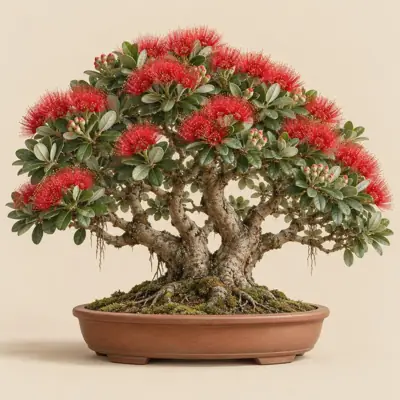
Metrosideros excelsa is a perennial evergreen woody plant that grows as an upright, much-branched tree, often with multiple trunks and a broad, roughly dome-shaped crown.
Overview
Metrosideros excelsa is a perennial evergreen woody plant that grows as an upright, much-branched tree, often with multiple trunks and a broad, roughly dome-shaped crown.
Origin and habitat
Metrosideros excelsa is native to New Zealand, with its main natural range in coastal parts of the North Island north of the New Plymouth–Gisborne line, as well as natural populations along the shores of Lake Rotorua; sources differ, with some also listing Abel Tasman National Park or the Three Kings Islands. It occurs mainly in coastal forests, on coasts and cliffs, and along lakeshores in the Rotorua area, and can grow on near-vertical cliffs and lava terrain. It is adapted to mild maritime environments and tolerates coastal winds, salt-laden winds, and some dryness, but has limited cold tolerance, with seedlings particularly sensitive to frost.
Characteristics
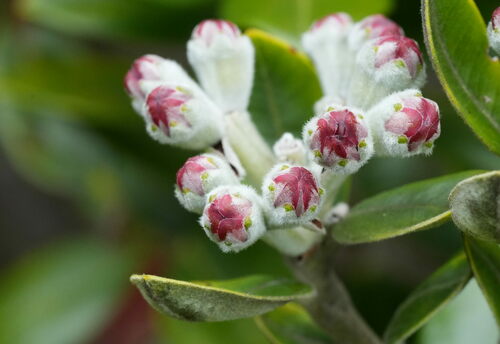
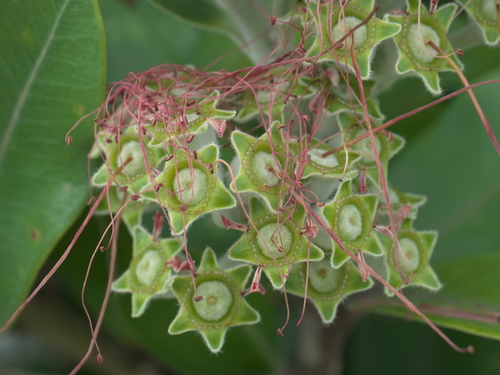
Sources differ on mature height, placing it at about 1500–2000 cm, while mature spread is 1000–3500 cm; sources also disagree on growth rate, describing it as either fast or slow growing. The simple leaves are thick and leathery, elliptic, oblong to obovate, dark green and slightly glossy above, and densely covered with white to gray-white hairs beneath. The flowers have a brush-like appearance formed by masses of conspicuous stamens; they are typically bright red to deep red, with pink, orange, yellow, or white variants, and the cultivar 'Aurea' has yellow flowers. Flowering in New Zealand is reported to occur over a period that reaches its main peak toward the latter part of that period and can continue later in some locations; the fruit is reported to be a small, hairy capsule that splits into lobes when mature and contains many small, light seeds.
Light
It grows in full sun; greenhouse cultivation requires ample light, though some shade can be provided under hot, intense light.
Watering
The growing medium should drain well while retaining some moisture; ample watering is recommended during active growth, with less watering at other times.
Temperature and dormancy
A lower temperature limit of about -5 °C is reported from a single source, so sources are few.
Growing medium and mounting
It prefers well-drained soil that retains some moisture and can be grown in loamy or sandy media; it tolerates some variation in soil type but is unsuited to poorly drained media.
Feeding
A single source recommends applying a balanced liquid fertilizer regularly during the growing period.
Propagation
It can be propagated by seed or cuttings; sowing is recommended earlier in the growing period, while semi-ripe cuttings can be taken later, with bottom heat used in one recommendation.
Common problems
In wild New Zealand populations, introduced brushtail possums are reported to be an important threat because they eat leaves and buds and, in severe cases, can weaken or kill plants; myrtle rust is also reported as a possible threat, with particular concern for important old trees at Cape Reinga. Cultivation in cold areas is limited by low temperatures, and seedlings are particularly frost-sensitive; in some regions, plants that escape cultivation can spread by self-seeding and are regarded as invasive. It tolerates coastal winds, salt-laden winds, and some dryness well, but has weaker cold tolerance, with young plants especially susceptible to frost damage.
Identification
Metrosideros excelsa can be recognized by its broad crown, dense white hairs on the undersides of the leaves, fibrous aerial roots, conspicuous brush-like flowers formed by masses of red stamens, and ability to grow attached to steep cliffs.
Photos


Sources
- Wikipedia (en): Pōhutukawa — CC BY-SA 4.0 · link
- Wikipedia (ja): メトロシデロス・エクスケルサ — CC BY-SA 4.0 · link
- Wikipedia (de): Metrosideros excelsa — CC BY-SA 4.0 · link
- Wikipedia (fr): Pohutukawa — CC BY-SA 4.0 · link
- Wikipedia (es): Metrosideros excelsa — CC BY-SA 4.0 · link
- GBIF descriptions: Arbolado urbano de Bogotá D.C asociado a servicios ambientales y culturales valorados como base de l — per dataset · link
- Useful Tropical/Temperate Plants: Metrosideros excelsa — CC BY-NC-SA 3.0 (facts only) · link
- RHS Plants: Metrosideros excelsa — © RHS, facts only · link