
Veitch's Masdevallia (Masdevallia veitchiana)
Masdevallia veitchiana is a clumping, upright orchid that is mainly terrestrial, can also grow on rocks, and is occasionally epiphytic. It is reported to be perennial.
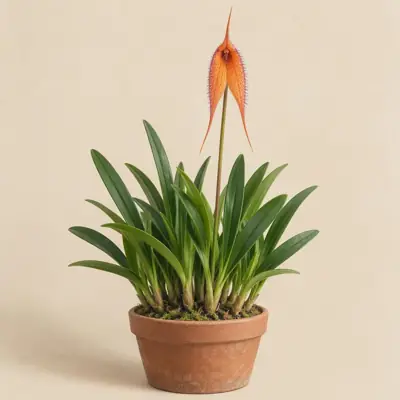
Overview
Masdevallia veitchiana is a clumping, upright orchid that is mainly terrestrial, can also grow on rocks, and is occasionally epiphytic. It is reported to be perennial.
Origin and habitat
Masdevallia veitchiana is native to Peru, with particular records from Machu Picchu in Cusco Province and nearby areas. It inhabits steep Andean rocky slopes among herbs and shrubs, mainly growing terrestrially but also on rocks and occasionally as an epiphyte; its natural environment can receive ample sunlight, while surrounding grasses often shade the leaves. Its habitat is high-elevation, cool, and humid.
Characteristics
Sources differ on mature height, placing it at about 10–50 cm, while the few available sources report a mature spread of about 10–50 cm. It is reported to grow quickly and can develop vigorously into clumps. Sources differ in describing the leaves; they are upright, thick, narrow, linear-oblanceolate, pointed at the tip, and taper into a grooved petiole, arising in clumps from a short-stemmed rhizome. The inflorescence bears a single large, long-lasting flower, mainly orange to orange-red, with fine purple hair-like projections on the sepals that can create a prismatic or iridescent effect; sources differ on the flowering season, describing it mainly from spring to early summer.
Light
Bright partial shade is suitable in cultivation, with enough light to support consistent flowering and strong flower stalks while avoiding overly intense exposure. It is suited to medium light.
Watering
During active growth, water thoroughly enough to keep the medium consistently slightly moist without waterlogging; reduce watering in autumn and winter without allowing the medium to dry completely. Keep slightly dry.
Humidity and airflow
The few specialist sources report humidity of about 60–90 %. Masdevallia veitchiana prefers high humidity and needs moderate airflow.
Temperature and dormancy
The few available sources report an ideal temperature of about 15–25 °C and a minimum of about 5 °C. It is generally listed as RHS H2 and as frost tender; keep above freezing. It is cool-growing.
Growing medium and mounting
Use a well-drained but moisture-retentive orchid medium such as sphagnum, fine bark, tree-fern fiber, sand, or an orchid medium amended with grit; RHS lists loamy or sandy soil and acidic, neutral, or alkaline pH. It is terrestrial and is reported to have fine terrestrial roots. A bark and sphagnum mix is a suitable medium preference.
Feeding
During active growth, use a dilute, balanced fertilizer; RHS recommends orchid fertilizer periodically with watering, AOS recommends a diluted standard concentration, and NHK recommends very dilute liquid fertilizer in spring and autumn while avoiding hot summer conditions.
Propagation
Sources differ on propagation guidance: Masdevallia veitchiana can be propagated by division and also from seed, and divisions should retain a sufficiently large clump of leaves.
Common problems
Potential pests include aphids, mealybugs, and greenhouse red spider mites. Obvious disease problems are generally uncommon, but humid conditions should be paired with airflow to reduce the risk of damage from leaf-spot fungi. Insufficient light can produce weak flower stalks and drooping flowers; dryness, low humidity, or high temperatures can cause abnormal growth, leaf loss, or plant decline, while high levels of dissolved salts in water can blacken leaf tips. It prefers cool conditions, is sensitive to summer heat, and should not be exposed to severe frost or freezing.
Identification
Masdevallia veitchiana is distinguished by a large orange single flower held above the foliage and by fine purple hair-like projections on the sepals that produce a distinctive prismatic effect depending on viewing angle and light.
Photos


Sources
- Wikipedia (en): Masdevallia veitchiana — CC BY-SA 4.0 · link
- RHS Plants: Masdevallia veitchiana — © RHS, facts only · link
- Internet Orchid Species Photo Encyclopedia: Masdevallia veitchiana — © Jay Pfahl / IOSPE contributors, facts only · link
- AOS culture sheet: Masdevallia (genus-level) — © American Orchid Society, facts only · link
- NHK みんなの趣味の園芸 植物図鑑: Masdevallia veitchiana — © NHK出版, facts only · link
- NC State Plant Toolbox: Masdevallia (genus-level) — copyright (facts only) · link