
Common Liverwort (Marchantia polymorpha)
Marchantia polymorpha is a large thalloid bryophyte and a non-vascular plant, with a flat thallus that grows close to the substrate and often forms mat-like cover. It alternates between gametophyte and sporophyte generations; the main visible plant body is the haploid gametophyte, male and female plants are separate, and it can also reproduce asexually by gemmae.
Overview
Marchantia polymorpha is a large thalloid bryophyte and a non-vascular plant, with a flat thallus that grows close to the substrate and often forms mat-like cover. It alternates between gametophyte and sporophyte generations; the main visible plant body is the haploid gametophyte, male and female plants are separate, and it can also reproduce asexually by gemmae.
Origin and habitat
Marchantia polymorpha is widely distributed globally; sources differ in their accounts of native status and distribution, including records from Taiwan, North America, the Andes, and Sierra Nevada de Santa Marta. It mainly grows on cool, moist soil or rocks and also occurs along streams and ponds, in marshes, peat wetlands, dune depressions, gardens, paths, greenhouses, agricultural settings, and urban environments; some groups or populations can be semi-aquatic in marshes or ponds with unstable water levels. Its distribution extends from tropical to Arctic regions, indicating a broad range of adaptation, while its growing environments share the presence of moisture or humidity.
Characteristics
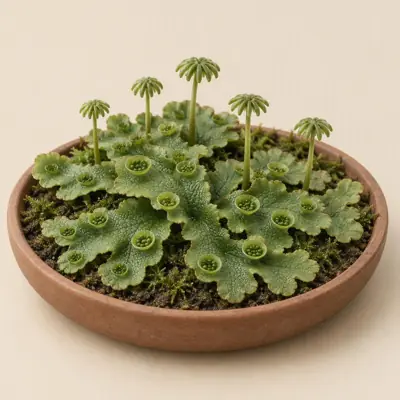
With few source data, its mature spread is reported to be about 3–10 cm. It has no true leaves; its main body is a green, flat, repeatedly dichotomously branching thallus, with sources differing in descriptions that include polygonal or scale-like surface patterns and pores, rhizoids and ventral scales underneath, and brown, purplish-brown, or darker coloration with age. It does not flower; sexual reproduction is reported to occur through male and female gametangiophores, with male structures described as disc-like or flattened and female structures as star-shaped or umbrella-like with deeply divided radiating structures, and sexual reproductive structures may be produced from spring to summer. It does not produce fruit; after fertilization, a sporophyte attached to the female gametophyte is reported to form and produce spores.
Light
Marchantia polymorpha can grow in shaded conditions and can also use artificial light; natural light is not an absolute requirement for its growth and reproduction.
Watering
It prefers consistently moist environments, commonly occurs in frequently irrigated cultivated areas, and its gemmae can be dispersed by splashing rain or irrigation water; some populations can live in semi-aquatic environments.
Growing medium and mounting
It is reported to grow on moist soil and rock surfaces without strict requirements for particular soil conditions, and it can also colonize pots, gaps in paving, and exposed mineral soil after fire.
Propagation
It can reproduce sexually by spores and asexually through gemmae in gemma cups on the thallus surface; gemmae are often dispersed by splashing rain or irrigation water.
Common problems
In gardens, nurseries, propagation areas, and greenhouses, Marchantia polymorpha can become a difficult-to-manage weed; contaminated propagation material may help spread it between locations, while frequently irrigated environments particularly favor its growth and the dispersal of gemmae.
Identification
Marchantia polymorpha is reported to have a flat, dichotomously branching thallus that grows along the ground, with rhizoids underneath that anchor the plant and cup-shaped gemma cups that can form on the thallus surface. Male and female plants are separate; male gametangiophores are reported to be nearly disc-shaped, while female gametangiophores are conspicuously star-shaped or umbrella-like.
Photos


Sources
- Wikipedia (en): Marchantia polymorpha — CC BY-SA 4.0 · link
- 維基百科:地钱 — CC BY-SA 4.0 · link
- Wikipedia (ja): ゼニゴケ — CC BY-SA 4.0 · link
- Wikipedia (de): Brunnenlebermoos — CC BY-SA 4.0 · link
- Wikipedia (fr): Hépatique des fontaines — CC BY-SA 4.0 · link
- GBIF descriptions: Catálogo de Plantas y Líquenes de Colombia; Validated red lists of Flanders, Belgium; Lipoxygenase p — per dataset · link
- NC State Plant Toolbox: Marchantia polymorpha — copyright (facts only) · link
- TaiCOL 臺灣物種名錄: Marchantia polymorpha — CC BY 4.0 · link
- USDA PLANTS Database: Marchantia polymorpha — Public domain (US Government work) · link