
Brazilian jasmine (Mandevilla sanderi)
Mandevilla sanderi is a perennial evergreen plant. Sources differ in describing its habit: it is a woody evergreen vine that can initially appear shrub-like before climbing supports with long, woody, twining stems.
Overview
Mandevilla sanderi is a perennial evergreen plant. Sources differ in describing its habit: it is a woody evergreen vine that can initially appear shrub-like before climbing supports with long, woody, twining stems.
Origin and habitat
Mandevilla sanderi is native to Brazil, with its natural range more specifically identified as the state of Rio de Janeiro. It is reported to occur in mountainous forest around Serra dos Órgãos near Rio de Janeiro, primarily in a tropical wet biome. It is suited to warm conditions; its native environment is tropical and wet, and it is also widely grown in containers in temperate regions.
Characteristics
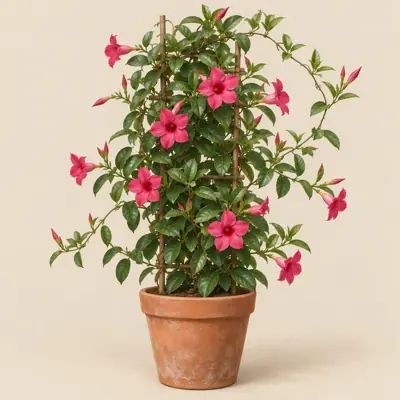
Sources differ, with the few available accounts placing mature height at about 200–450 cm. It grows rapidly. The evergreen, stalked leaves are opposite, thick, leathery, and dark green, with glossy upper surfaces, short-pointed tips, and elliptical to ovate-elliptical shapes. Sources differ in their descriptions of the large, funnel-shaped flowers; they are typically pink to red with a lobed corolla. Sources differ on flowering season: flowering is mainly from spring through autumn, while Taiwan horticultural information emphasizes summer and autumn, with flowering potentially extending or continuing year-round in hot regions; the dry fruit consists of a pair of slender follicles that split lengthwise at maturity.
Light
It does well in bright, warm conditions with abundant sunlight, from full sun to slight shade, while intense outdoor midday sun should be avoided because it can cause damage.
Watering
Water regularly during flowering while allowing the growing medium to dry moderately between waterings, and avoid prolonged wetness; reduce watering indoors in winter. Established plants have some drought tolerance, but prolonged drought can affect new shoots and flowering.
Humidity and airflow
It is reported to prefer high humidity and to need little air movement.
Temperature and dormancy
The few available sources report an ideal temperature of about 25–30 °C. It is reported to be frost tender; keep above freezing.
Growing medium and mounting
It is generally grown in well-drained potting mix or sandy loam.
Feeding
Sources differ on feeding: slow-release fertilizer may be applied from spring through autumn, while liquid flowering fertilizer may be used during peak flowering; another recommendation is to apply flowering-plant fertilizer with watering in summer.
Propagation
It is reported to be propagated from cuttings in the warm season, using established shoots with excess leaves removed, followed by rooting treatment and insertion into growing medium while maintaining humidity and temperature until roots develop.
Common problems
It is sensitive to frost, which sources indicate can be fatal; cold spells can halt growth or cause leaf drop, while intense outdoor midday sun can also cause damage. Persistently wet growing medium is unfavorable to growth, prolonged drought can impair new-shoot development and flowering, and winter cold spells may stop growth or cause leaf drop.
Identification
Distinguishing features include woody twining stems, sticky white sap, large tuberous roots, thick, leathery, glossy opposite leaves, and large funnel-shaped pink to red flowers; the flower buds are described as resembling cicada pupae.
Photos


Sources
- Wikipedia (en): Mandevilla sanderi — CC BY-SA 4.0 · link
- Wikipedia (fr): Mandevilla sanderi — CC BY-SA 4.0 · link
- Wikipedia (es): Mandevilla sanderi — CC BY-SA 4.0 · link
- GBIF descriptions: Lista de especies de plantas exóticas y trasplantadas de Colombia; Catálogo de Plantas y Líquenes de — per dataset · link
- 農業知識入口網 植物圖鑑: Mandevilla sanderi — © MOA, facts only · link
- NC State Plant Toolbox: Mandevilla (genus-level) — copyright (facts only) · link