
feather cactus (Mammillaria plumosa)
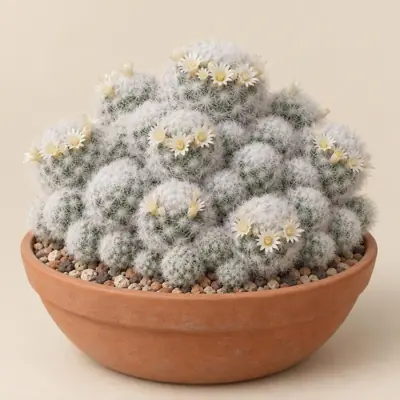
Mammillaria plumosa is a clustering cactus whose spherical to slightly elongated stems form low, dense mounds.
Overview
Mammillaria plumosa is a clustering cactus whose spherical to slightly elongated stems form low, dense mounds.
Origin and habitat
It is native to northeastern Mexico, occurring in Coahuila, Nuevo León, and parts of Tamaulipas. It grows on limestone cliffs and in sparse xeric scrub in dry environments with strong sunlight.
Characteristics
Sources differ on mature size, placing height at about 6–12 cm and spread at about 10–50 cm. The flowers are commonly white, creamy white to yellowish white, with reports also describing dark pink flowers or flowers with pink or red midlines; they are usually arranged in a ring on the plant. Flowering occurs in late summer. One specialist source reports that offset formation is initially slow, after which clustering becomes more pronounced and large clumps can develop over time; sources differ in describing the fruit as cuboid and dark purplish red or as small-pepper-shaped and pinkish brown.
Light
Mammillaria plumosa takes full sun and can be grown in bright conditions; in summer it may receive full sun or bright shade, with some shade suitable in intensely hot areas, while greenhouse guidance also recommends bright filtered light.
Watering
During active growth, water moderately to regularly while maintaining good drainage, and avoid wetting the white feathery spines when watering. Sources differ on winter watering: some recommend keeping it almost dry, while others caution against allowing the growing medium to become excessively dry.
Humidity and airflow
It is generally reported to prefer low humidity and need good airflow.
Temperature and dormancy
Sources differ on the reported minimum temperature, with a value of about 5 °C given. Specialist sources report hardiness ratings for the plant. It is generally reported to be frost hardy and to rest cool and dry in winter. A single source gives a cold minimum of about 6 °C.
Growing medium and mounting
Use a well-drained cactus growing medium, which may be loamy or sandy; some sources recommend adding charcoal and gravel.
Feeding
A single source recommends applying a balanced liquid fertilizer during the growing period.
Propagation
Mammillaria plumosa can be propagated by seed or offsets, and specialist guidance also lists cuttings as a propagation method.
Common problems
Mealybugs may affect the plant, and scale insects have also been recorded for the genus Mammillaria. One source reports that disease problems are generally uncommon. Prolonged wetness in the growing medium can lead to rot and root loss, while wetting the white feathery spines during watering can affect the plant's appearance. It does not tolerate cold conditions and in temperate areas is generally grown in an insulated glasshouse; in hot areas with intense light, some summer shade can be provided.
Identification
The stems are densely covered with white, soft radial spines bearing long hairs that give them a feathery appearance; central spines are usually absent, making the plant appear covered in white down.
Photos


Sources
- Wikipedia (en): Mammillaria plumosa — CC BY-SA 4.0 · link
- Wikipedia (de): Mammillaria plumosa — CC BY-SA 4.0 · link
- Wikipedia (fr): Mammillaria plumosa — CC BY-SA 4.0 · link
- Wikipedia (es): Mammillaria plumosa — CC BY-SA 4.0 · link
- LLIFLE Encyclopedia of living forms: Mammillaria plumosa — CC BY-SA · link
- RHS Plants: Mammillaria plumosa — © RHS, facts only · link
- Desert-Tropicals: Mammillaria plumosa — © Philippe Faucon (desert-tropicals.com), facts only · link
- NC State Plant Toolbox: Mammillaria (genus-level) — copyright (facts only) · link
- PUKUBOOK: Mammillaria plumosa — CC BY-NC (facts only) · link