
Mammillaria gracilis (Mammillaria gracilis)
Mammillaria gracilis is a small, succulent, shrubby cactus with cylindrical stems that branch freely to form clustering, cushion-like colonies. It is reported to be perennial.
Overview
Mammillaria gracilis is a small, succulent, shrubby cactus with cylindrical stems that branch freely to form clustering, cushion-like colonies. It is reported to be perennial.
Origin and habitat
Sources differ on its native range, which is described as Hidalgo and Querétaro in eastern Mexico. It occurs in dry scrub and rocky habitats, with records from elevated sites and a type specimen found in leaf litter beneath shrubs on limestone. It is adapted to dry conditions and prolonged periods with little water, can tolerate light frost when kept dry, and is unsuited to cold, wet conditions.
Characteristics
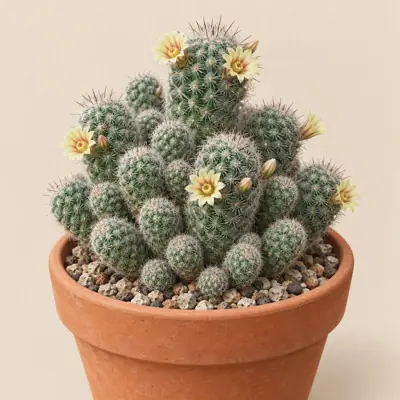
Sources differ on mature height, reported at about 7.62–15.24 cm, while the few available sources report a mature spread of about 10.16–12.7 cm. Growth is slow, but the plant readily produces many offsets and expands into colonies. Sources differ in describing the small, pale yellow to creamy white flowers, some with a pink to brown central stripe, and their shape ranges from funnel-like to bell-like; flowering occurs in spring and may recur from late summer into autumn. The plant has no leaves; its small fruits are red or pinkish white and may become fleshy red when mature, while the seeds are black.
Light
Full sun to bright direct light is best, with afternoon shade possible in hot weather, and the plant can also adapt to moderate shade. When moving a plant from shade into full sun, increase light gradually to avoid sunburn.
Watering
It is drought tolerant; during the growing season, water lightly to moderately and allow the growing medium to dry completely before watering again. In winter, stop or greatly reduce watering to avoid prolonged wetness and root rot.
Humidity and airflow
It is generally reported to need good airflow.
Temperature and dormancy
Sources differ on the lower temperature limit, reported at about -4 °C, while the few available sources report an upper limit of about 37.8 °C. A USDA hardiness zone is reported, though the available claim does not provide it in a form that can be stated numerically here. It tolerates brief light frost and rests cool and dry in winter. A specialist source reports a cold minimum of about -4 °C, but sources are few.
Growing medium and mounting
It needs a fast-draining sandy or cactus growing medium; coarse sand, pumice, or perlite can be added to increase the mineral component and drainage. It prefers a slightly acidic to neutral growing medium.
Propagation
Sources differ on propagation methods: readily detached offsets or stem cuttings can be used, and some sources also record propagation by seed. Supported propagation methods include stem cuttings and seed, as well as readily detached offsets.
Common problems
Overwatering can cause rot, loosely attached offsets readily detach when handled or disturbed, and plants grown in shade can suffer severe sunburn if suddenly moved into strong sunlight. It can tolerate light frost when dry but is unsuited to cold, wet conditions, and commercial sources advise against exposing it to severe frost.
Identification
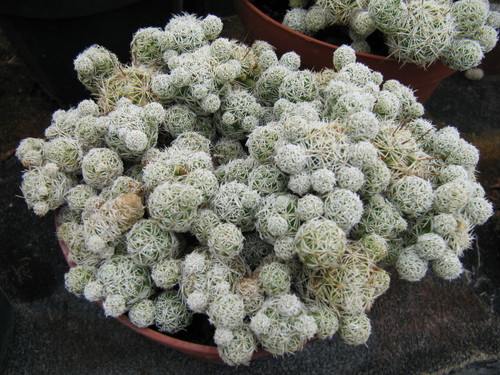
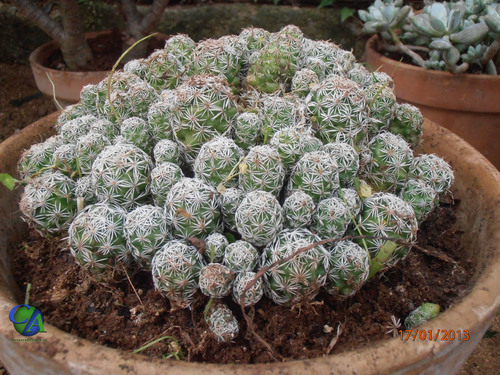
The stems are slender and cylindrical with rounded tubercles; each areole typically bears numerous white radial spines, while central spines are often absent or few and are more likely to occur on mature stems. The plant produces many offsets that are loosely attached, detach readily, and can root again.
Photos


Sources
- GBIF Backbone: Mammillaria gracilis Pfeiff. — CC BY 4.0 · link
- Wikipedia (en): Mammillaria vetula — CC BY-SA 4.0 · link
- Wikipedia (en): Mammillaria gracilis — CC BY-SA 4.0 · link
- NC State Plant Toolbox: Mammillaria gracilis — copyright (facts only) · link
- LLIFLE Encyclopedia of living forms: Mammillaria gracilis — CC BY-SA · link
- The Succulent Plant Page: Mammillaria (genus-level) — © R.J. Hodgkiss, facts only · link
- Mammillaria gracilis fragilis - Thimble Cactus | MCG™ (mountaincrestgardens.com) — facts only (§12) · link
- Mammillaria gracilis | Giromagi cactus and succulents for sale | Buy plants onli (www.giromagi.com) — facts only (§12) · link
- PUKUBOOK: Mammillaria gracilis — CC BY-NC (facts only) · link