
Apple (Malus domestica)
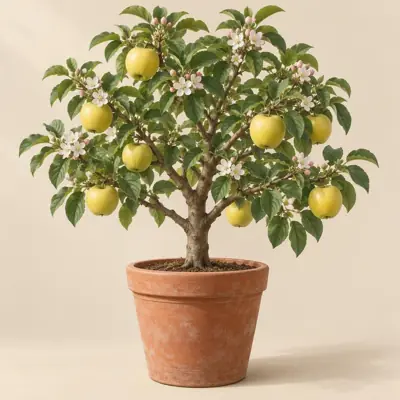
Malus domestica is a perennial deciduous woody plant, typically a tree, although rootstocks and cultivation methods can markedly dwarf it and some sources describe tree-like or shrub-like growth forms.
Overview
Malus domestica is a perennial deciduous woody plant, typically a tree, although rootstocks and cultivation methods can markedly dwarf it and some sources describe tree-like or shrub-like growth forms.
Origin and habitat
Sources differ in their accounts, with Central Asia given as the native range. GBIF records are reported from deciduous, coniferous and mixed forests, forest edges, shrubland, rocky areas, farmland, gardens and parks. It is reported to be widely cultivated mainly in temperate regions, entering winter dormancy after leaf fall in autumn and budding and flowering in spring after exposure to cold conditions.
Characteristics
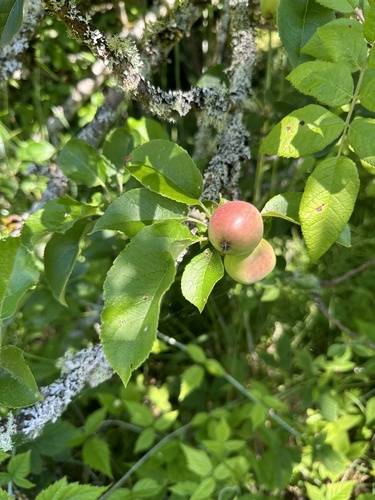
Sources differ on mature height, giving a range of about 180–460 cm, while the few available sources indicate a mature spread of about 0–914.4 cm. Leaves are alternate, usually elliptic, ovate to nearly round, and green with mostly serrated margins; some sources describe soft hairs on the undersides. Flowers are usually white to pale pink and occur in clusters or cymose inflorescences; central or earlier-forming flowers generally open earlier and may produce larger fruit, and flowering occurs in spring. The fruit is usually nearly spherical and may be slightly indented at the top and bottom, generally maturing from late summer into autumn; cultivar skins may be red, yellow, green, pink, brown, bicolored or tricolored, while the flesh is usually pale yellow-white.
Light
It grows in full sun to partial sun.
Watering
It is reported to prefer moist but well-drained soil, while RHS also reports that mature plants can adapt to alternating wet and dry conditions.
Temperature and dormancy
RHS assigns Malus domestica a hardiness rating.
Growing medium and mounting
It can grow in chalk, clay, loam and sand, prefers moist but well-drained conditions, and tolerates acidic, neutral or alkaline soils; NC State also describes it as adaptable to various soils.
Propagation
Cultivars are usually propagated vegetatively by grafting onto rootstocks to maintain cultivar characteristics, with rootstocks also used to control growth rate and plant size. Seed-grown offspring often differ greatly from the parent plants.
Common problems
Malus domestica may experience many pest problems, with NC State listing examples including white apple leafhopper, apple leafroller-type pests and apple maggot. It is susceptible to various fungal and bacterial diseases, including problems identified by NC State such as apple powdery mildew and cedar-apple rust. Apple trees may face broad disease and pest pressure and may require regular pest and disease management in cultivation.
Identification
Malus domestica is a deciduous fruit tree with serrated green leaves and white to pale pink spring flowers followed by large pome fruit; rootstock and pruning can strongly influence tree size and crown form.
Photos


Sources
- Wikipedia (en): Apple — CC BY-SA 4.0 · link
- 維基百科:苹果 — CC BY-SA 4.0 · link
- Wikipedia (en): Malus domestica — CC BY-SA 4.0 · link
- Wikipedia (ja): セイヨウリンゴ — CC BY-SA 4.0 · link
- Wikipedia (de): Kulturapfel — CC BY-SA 4.0 · link
- Wikipedia (es): Malus domestica — CC BY-SA 4.0 · link
- GBIF descriptions: Checklist of introduced taxa in Cyprus; Database of Vascular Plants of Canada (VASCAN); Checklist of — per dataset · link
- NC State Plant Toolbox: Malus domestica — copyright (facts only) · link
- RHS Plants: Malus domestica — © RHS, facts only · link
- USDA PLANTS Database: Malus domestica — Public domain (US Government work) · link