
Japanese Climbing Fern (Lygodium japonicum)
Lygodium japonicum is a perennial, terrestrial, herbaceous climbing fern with an underground spreading rhizome and a leaf axis that can twine around other plants as it climbs.
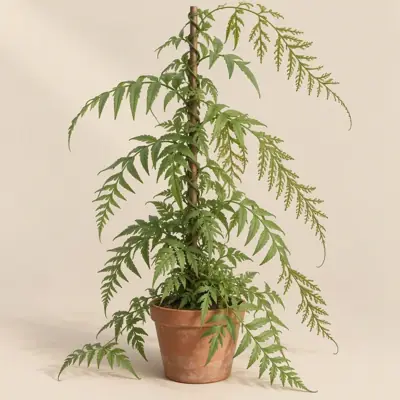
Overview
Lygodium japonicum is a perennial, terrestrial, herbaceous climbing fern with an underground spreading rhizome and a leaf axis that can twine around other plants as it climbs.
Origin and habitat
Its native range extends from eastern Asia through South Asia and Southeast Asia to New Guinea, including China, Japan, Korea, Taiwan, the Indian subcontinent, Myanmar, Thailand, Cambodia, Laos, Vietnam, Malaysia, Indonesia, and the Philippines, with Taiwan within its native range; sources differ on whether eastern Australia is also native range. It occurs climbing on trees and shrubs in secondary forest and also in moist, swampy, and disturbed environments, while records also include drier pine flats, roadsides, and sunny sites. Its distribution spans warm to tropical regions; it can be evergreen in tropical environments and deciduous where frost occurs, and some wild tropical populations occur in areas with a distinct dry season.
Characteristics
Sources differ, but mature height is reported at about 1000–2743 cm. A single source reports a mature spread of about 305–305 cm, so sources are few. The leaves are very long, with a vine-like axis that can continue growing and twine as it climbs; structures that look like leaves along the vine are actually pinnae or leaflets, with narrower vegetative portions and more finely divided fertile portions bearing sporangia along their margins. It has a creeping rhizome.
Light
It can grow from full sun to partial shade or shade and tolerates part sun.
Watering
Regular watering and continuously moist conditions are preferred, although it can also occur in drier pine flats. It is generally reported to do best when kept evenly moist.
Temperature and dormancy
A single source reports a hardiness-zone range without a confirmed numerical rendering here. It is generally described as frost tender and tender, and should be kept above freezing.
Growing medium and mounting
It prefers well-drained loam, while container-growing sources recommend soil and peat-like media that retain moisture.
Propagation
It reproduces by spores and can also propagate vegetatively through underground rhizomes; spores can disperse by wind. A single source reports that spores form along the margins of the lacy leaf portions and are dispersed by wind.
Common problems
No major pest problems are generally reported. It grows rapidly, can cover and suppress trees, and can form dense ground cover that interferes with seed germination; in the southeastern United States it is an invasive plant with economic and ecological impacts, can regrow rapidly after fire, and its climbing growth can form a fuel ladder that carries flames toward tree crowns during forest fires. It is sensitive to frost, and foliage can die back or become deciduous where frost occurs; sources also report rapid regrowth after fire.
Identification
A prominent identifying feature is the long leaf axis, actually part of a single leaf, which twines around other plants like a vine; it has vegetative and fertile pinnae, with sporangia forming along the margins of the fertile portions.
Photos


Sources
- Wikipedia (en): Lygodium japonicum — CC BY-SA 4.0 · link
- 維基百科:海金沙 — CC BY-SA 4.0 · link
- Wikipedia (ja): カニクサ — CC BY-SA 4.0 · link
- Wikipedia (fr): Lygodium japonicum — CC BY-SA 4.0 · link
- Wikipedia (es): Lygodium japonicum — CC BY-SA 4.0 · link
- NC State Plant Toolbox: Lygodium japonicum — copyright (facts only) · link
- TaiCOL 臺灣物種名錄: Lygodium japonicum — CC BY 4.0 · link
- Useful Tropical/Temperate Plants: Lygodium japonicum — CC BY-NC-SA 3.0 (facts only) · link
- USDA PLANTS Database: Lygodium japonicum — Public domain (US Government work) · link
- Top Tropicals catalog: Lygodium japonicum — © Top Tropicals LLC (facts only) · link