
red spider lily (Lycoris radiata)
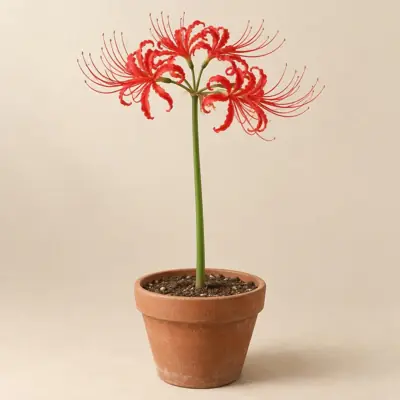
Lycoris radiata is a bulbous perennial herb with an underground bulb and usually leafless flowering stems.
Overview
Lycoris radiata is a bulbous perennial herb with an underground bulb and usually leafless flowering stems.
Origin and habitat
Sources differ on its native range: its main native range is described as China, Korea, and Nepal; populations in Japan are usually described as introduced from China and widely naturalized, although some horticultural sources include Japan in the native range, while the Taiwan species checklist records it as native in Taiwan. It favors moist sites ranging from shade to sunny conditions and occurs on slopes, rocky ground, stream banks, field margins, embankments, roadsides, and other places influenced by human activity. It is suited to environments with a warm growing period, winters that are not excessively severe, and good drainage; its leaves continue growing in winter, so severe frost can cause damage.
Characteristics
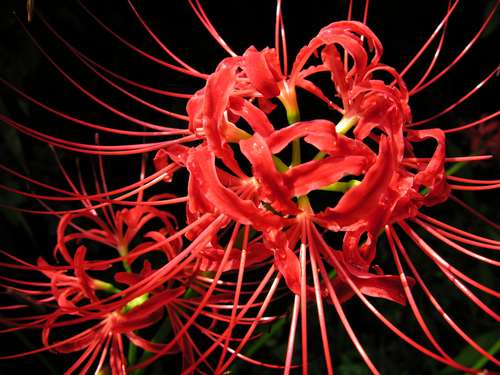
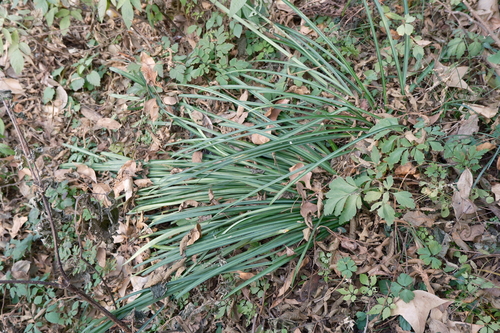
Sources differ on mature height, with reports suggesting about 30–60 cm, while a single source reports a mature spread of about 10–50 cm. Sources differ in their descriptions of the leaves, but they are described as narrow, linear to strap-shaped, dark green to gray-green, with a paler midrib; they usually emerge after flowering, remain through winter, and wither later. Sources differ in their descriptions of the flowers, which are bright red and clustered in umbels, with narrow, wavy-edged, strongly recurved tepals and long, projecting stamens and styles; flowering occurs from late summer into autumn, often around the autumnal equinox. It is reported to form capsules and seeds, but seed reproduction depends on ploidy: diploid forms are fertile, while common triploid forms are sterile.
Light
It grows in full sun to partial sun; some sources report better flowering in partial sun, while others recommend full sun.
Watering
During growth, it is suited to moist but well-drained soil; during dormancy, drier conditions are preferable and prolonged waterlogging should be avoided.
Temperature and dormancy
Sources differ on the lower temperature, with limited reporting suggesting about -5 °C, while a single source reports an upper temperature of about 24 °C.
Growing medium and mounting
It grows in fertile, organic-rich, well-drained soil and can adapt to sandy, loamy, and calcareous soils; sources differ on preferred soil pH, with RHS listing acidic, neutral, or alkaline conditions as suitable.
Feeding
A single source reports that base fertilizer can be applied at planting.
Propagation
Sources differ on propagation: bulb offsets can be separated, fertile diploid plants can also reproduce from seed, while sterile triploid forms rely mainly on vegetative propagation by bulbs.
Common problems
Narcissus bulb fly may cause damage, although RHS describes the plant as generally having few pest problems. Poor drainage or excessive moisture during dormancy does not meet its cultivation needs, while leaves growing through winter may suffer frost damage in cold areas. Severe winter frost can damage the leaves and gradually weaken the bulbs, while heavy rain from late summer into autumn may encourage flowering.
Identification
Flowers and leaves appear at different times: in autumn, leafless flowering stems emerge from underground bulbs and bear bright red flowers with recurved tepals and long projecting stamens, with the leaves emerging only after flowering.
Photos


Sources
- Wikipedia (en): Lycoris radiata — CC BY-SA 4.0 · link
- 維基百科:石蒜 — CC BY-SA 4.0 · link
- Wikipedia (ja): ヒガンバナ — CC BY-SA 4.0 · link
- Wikipedia (fr): Lycoris radiata — CC BY-SA 4.0 · link
- Wikipedia (es): Lycoris radiata — CC BY-SA 4.0 · link
- NC State Plant Toolbox: Lycoris radiata — copyright (facts only) · link
- TaiCOL 臺灣物種名錄: Lycoris radiata — CC BY 4.0 · link
- Useful Tropical/Temperate Plants: Lycoris radiata — CC BY-NC-SA 3.0 (facts only) · link
- RHS Plants: Lycoris radiata — © RHS, facts only · link
- USDA PLANTS Database: Lycoris radiata — Public domain (US Government work) · link