
golden hurricane-lily (Lycoris aurea)
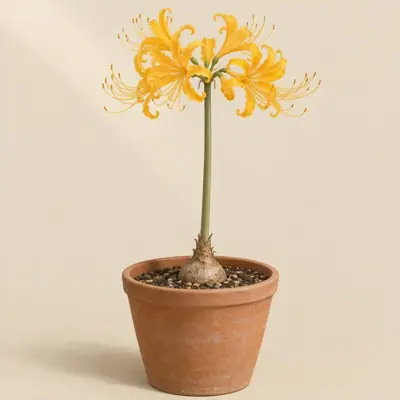
Lycoris aurea is a perennial bulbous herb with upright growth and usually leafless flower stalks.
Overview
Lycoris aurea is a perennial bulbous herb with upright growth and usually leafless flower stalks.
Origin and habitat
Sources differ on its native range in Asia; accounts explicitly include China, Taiwan, Japan, and parts of Southeast Asia, while Taiwan's species list recognizes it as native to Taiwan. In the wild, it occurs in habitats such as moist, shaded slopes and rock crevices. It is adapted to environments with a dormant season and, in cultivation, favors well-drained conditions that can be drier in summer while avoiding excessive winter moisture.
Characteristics
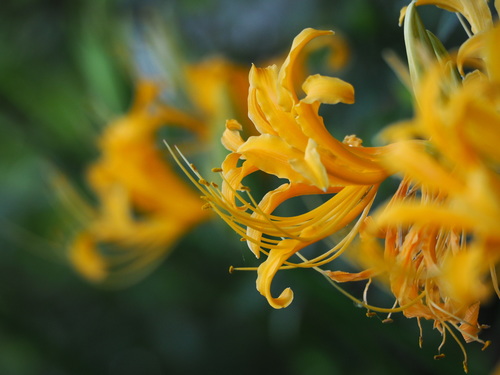
A single source reports a mature height of about 50–100 cm and a spread of about 10–50 cm, so sources are few for these ranges. Growth is moderate, while the bulb itself grows more slowly; the basal, somewhat fleshy leaves are linear to strap-shaped or oblong and strap-shaped, and usually emerge after flowering or in autumn. Sources differ in their flower descriptions: the flowers are yellow to orange-yellow in terminal umbels, with a tubular, funnel-shaped perianth, recurved and wavy-edged segments, and projecting stamens; sources also differ on the flowering period, placing it from late summer into autumn. The fruit is a nearly spherical capsule, and some plants may not set seed because not all are fertile.
Light
Sources differ somewhat on light: full sun to partial sun is reported, with partial sun described as better during flowering and overly strong sunlight during flowering discouraged.
Watering
While leaves are growing, maintain moderate and sufficient moisture without waterlogging; watering can be reduced somewhat during flowering, while dormancy should be drier and prolonged wet conditions in winter or summer should be avoided.
Temperature and dormancy
A single source reports a minimum temperature of about -15 °C, so sources are few. A single source also reports a USDA hardiness-zone rating.
Growing medium and mounting
Use fertile, well-drained soil such as sandy loam or loam; some sources also accept clay loam and chalky soil, and the plant tolerates a broad pH range but should not be waterlogged.
Feeding
A single source reports that liquid fertilizer may occasionally be applied while seedlings are growing to avoid nutrient deficiency.
Propagation
Lycoris aurea can be propagated by seed, bulb division, or separating offsets, with seed preferably sown soon after it matures. Growing from seed can take years to reach flowering, so bulb division is commonly the faster horticultural propagation method.
Common problems
Sources differ on pests: one reports narcissus bulb fly-related problems, another reports that slugs may feed on the plant, while another assesses it as generally having few pest problems. Known diseases are generally uncommon. Poor drainage or excessive moisture is unsuitable; containers that are too small may prevent flowering, and plants may take years to re-establish after transplanting or root disturbance. It is sensitive to prolonged moisture, particularly wet summers or overly wet winters; winter covering is recommended in cold areas, and excessively strong sunlight during flowering may cause flower-stalk bleaching.
Identification
Flower stalks arise directly from the ground and are leafless while flowering, with leaves emerging only after the flowers fade, so flowers and leaves appear at different times; the yellow perianth segments are conspicuously recurved with wavy edges.
Photos


Sources
- 維基百科:金花石蒜 — CC BY-SA 4.0 · link
- Wikipedia (es): Lycoris aurea — CC BY-SA 4.0 · link
- NC State Plant Toolbox: Lycoris aurea — copyright (facts only) · link
- TaiCOL 臺灣物種名錄: Lycoris aurea — CC BY 4.0 · link
- 農業知識入口網 植物圖鑑: Lycoris aurea — © MOA, facts only · link
- Useful Tropical/Temperate Plants: Lycoris aurea — CC BY-NC-SA 3.0 (facts only) · link
- RHS Plants: Lycoris aurea — © RHS, facts only · link