
fountain palm (Livistona chinensis)
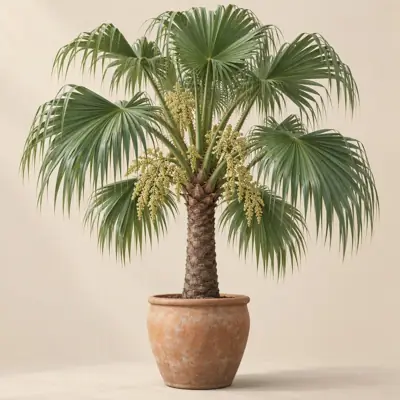
Livistona chinensis is a perennial evergreen palm that grows as a single, unbranched trunk.
Overview
Livistona chinensis is a perennial evergreen palm that grows as a single, unbranched trunk.
Origin and habitat
Sources differ on its native range: accounts broadly place it from parts of East Asia into Southeast Asia, consistently including southern China, Taiwan, and southern Japan or the Ryukyu Islands, while some extend the range to Vietnam. Its habitat includes subtropical coastal environments in East Asia, including coastal forests and various soils such as sandy ground. It is mainly subtropical and is also widely cultivated from warm-temperate to tropical regions, with hot, humid tropical and subtropical climates described as suitable.
Characteristics
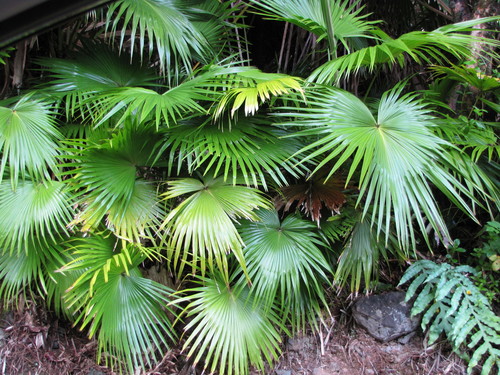
Sources differ on mature height, placing it at about 800–1500 cm, while mature spread is 250–400 cm. Growth is slow, with deeply divided, fan-shaped palmate leaves whose linear segment tips droop; the long, triangular petioles bear spines or saw-toothed barbs. The small yellow-green to creamy-yellow flowers are borne on branched panicles, and the plant is monoecious with bisexual flowers; sources differ on flowering season, describing flowering from spring into early summer or in summer. The fruit is an elliptical, ovoid to nearly spherical drupe that changes from green to blue-green, blue-black, or pinkish as it matures and usually contains a single seed.
Light
Sources differ on light conditions: cultivation is reported in full sun, partial sun, or bright indirect light, while some sources indicate a preference for light shade.
Watering
It prefers moist but well-drained conditions; ample water can be supplied during the growing season and watering reduced in winter, while some sources describe moderate watering.
Temperature and dormancy
A single source reports a lower temperature of about -6 °C, so sources are few. Sources differ on the reported USDA hardiness zone.
Growing medium and mounting
Loamy or sandy soil that is moist and well drained is suitable, and acidic, neutral, or alkaline soils are accepted.
Feeding
A single source generally recommends applying a balanced liquid fertilizer regularly during the growing period.
Propagation
Livistona chinensis is propagated by seed, with container sowing under warm conditions recommended in spring.
Common problems
It is reported to be susceptible to greenhouse red spider mites and scale insects, while generally having few diseases. Seeds germinate readily and can be dispersed by fruit-eating birds, allowing plants to escape cultivation; it is regarded as a weed or invasive plant on some Pacific and Caribbean islands and in Bermuda, Hawaii, and Florida wetlands. A source reports that mature plants have some cold tolerance while young plants are less cold tolerant, and also describes tolerance of heat, drought, wind, and salt.
Identification
Livistona chinensis has large, fan-shaped, deeply divided palmate leaves with conspicuously drooping tips on the narrow segments and spiny petioles; these features distinguish it from areca palms with pinnate leaves.
Photos



Sources
- Wikipedia (en): Livistona chinensis — CC BY-SA 4.0 · link
- 維基百科:蒲葵 — CC BY-SA 4.0 · link
- Wikipedia (ja): ビロウ — CC BY-SA 4.0 · link
- Wikipedia (fr): Livistona chinensis — CC BY-SA 4.0 · link
- Wikipedia (es): Livistona chinensis — CC BY-SA 4.0 · link
- GBIF descriptions: Lista de especies de plantas exóticas y trasplantadas de Colombia; Catálogo de Plantas y Líquenes de — per dataset · link
- TaiCOL 臺灣物種名錄: Livistona chinensis — CC BY 4.0 · link
- Useful Tropical/Temperate Plants: Livistona chinensis — CC BY-NC-SA 3.0 (facts only) · link
- RHS Plants: Livistona chinensis — © RHS, facts only · link
- USDA PLANTS Database: Livistona chinensis — Public domain (US Government work) · link