
West Indian spongeplant (Limnobium laevigatum)
Limnobium laevigatum is a perennial free-floating aquatic herb.
Overview
Limnobium laevigatum is a perennial free-floating aquatic herb.
Origin and habitat
Sources differ on the native range of Limnobium laevigatum: accounts include Mexico, Central America, the Caribbean and South America, while GBIF data describe a native distribution from Central America to Paraguay and Argentina; Taiwanese data describe it as native to South and Central America and as a naturalized non-native species in Taiwan. It is a floating plant of freshwater habitats, including lakes, ponds, slow-flowing or stagnant parts of rivers, waterways, freshwater ditches, marshes and flooded grasslands; Japanese data also describe it as common in slow-flowing lowland freshwater environments. It is reported to be native mainly to tropical and subtropical freshwater environments and to have been introduced to some warmer areas outside its native range.
Characteristics
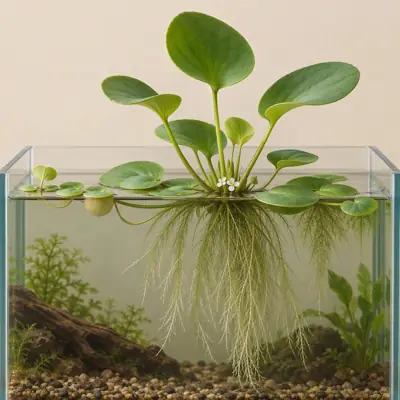
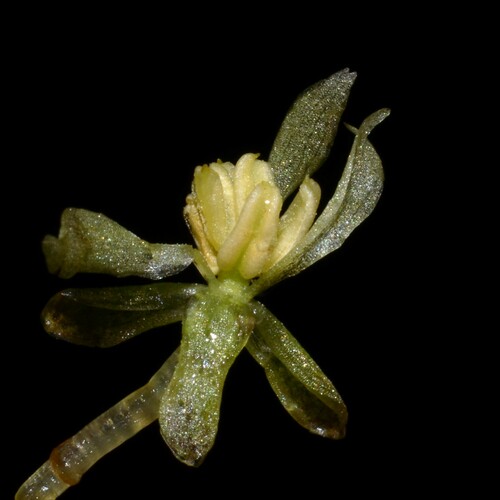
Sources are few, but mature height is reported to be about 0–50 cm. Sources differ in their descriptions of the leaves: young plants have rosettes lying flat on the water, with conspicuous spongy air-filled tissue beneath the leaves; the leaves are described as nearly round, and in dense or mature growth some may rise above the water, while mature petioles lack the swelling characteristic of water hyacinth. The flowers are reported to be small, white and unisexual, with male and female flowers on the same plant; female flowers have an inferior ovary, while male flowers are described as having sepals and petals. A source reports a distinct flowering season and describes the fruit as a fleshy capsule with elliptical, hairy seeds.
Watering
It is reported to require a freshwater environment as a floating plant, while prolonged droplets or splashing on the upper leaf surface should be avoided because the leaves can readily rot.
Temperature and dormancy
Sources are few, but the reported temperature limits are about 10 °C to 28 °C.
Feeding
It is reported to absorb nutrients such as nitrate and phosphate from the water, while yellow leaves may indicate iron deficiency.
Propagation
It is reported to reproduce sexually by seeds formed after pollination and vegetatively when stolon segments break apart; stolon nodes can also form roots and rosettes of leaves.
Common problems
Some aquatic snails are reported to feed on the spongy tissue beneath the leaves. Persistent water or splashing on the upper leaf surface is reported to cause rot, while yellow leaves may be associated with iron deficiency. When growth is vigorous, it is reported to form dense floating mats that can rapidly cover the water surface. It is described as a tropical to subtropical aquatic plant, with a source reporting favorable aquarium growth within a temperature range, without a confirmed numeric range here.
Identification
The most distinctive feature reported for young plants is the spongy air-filled tissue beneath the leaves; the floating leaves are generally more spoon-shaped, distinguishing them from Hydrocharis spongia, whose leaf bases are usually more heart-shaped. Mature leaves can rise above the water, and their petioles lack the swollen flotation structures characteristic of water hyacinth.
Photos


Sources
- GBIF Backbone: Limnobium laevigatum (Humb. & Bonpl. ex Willd.) Heine — CC BY 4.0 · link
- Wikipedia (en): Limnobium laevigatum — CC BY-SA 4.0 · link
- Wikipedia (ja): アマゾントチカガミ — CC BY-SA 4.0 · link
- Wikipedia (de): Südamerikanischer Froschbiss — CC BY-SA 4.0 · link
- GBIF descriptions: Manual of the Alien Plants of Belgium; Catálogo de Plantas y Líquenes de Colombia; Flora y fauna de — per dataset · link
- TaiCOL 臺灣物種名錄: Limnobium laevigatum — CC BY 4.0 · link
- USDA PLANTS Database: Limnobium laevigatum — Public domain (US Government work) · link