
Easter lily (Lilium longiflorum)
Lilium longiflorum is a bulbous perennial herb with an upright leafy stem.
Overview
Lilium longiflorum is a bulbous perennial herb with an upright leafy stem.
Origin and habitat
Sources differ on its native range: it is native around Taiwan and Japan's Ryukyu Islands, while some sources extend the range to southern Japan or the Philippines. It occurs on coasts and sea cliffs, on calcareous or coral-rock ground, and also in grasslands, on slopes, and in more fertile, moist environments. It is reported to prefer warmer conditions; in cooler regions, a warm, sheltered position with protection from early frost is recommended.
Characteristics
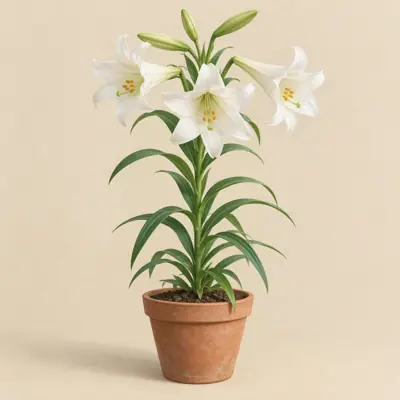
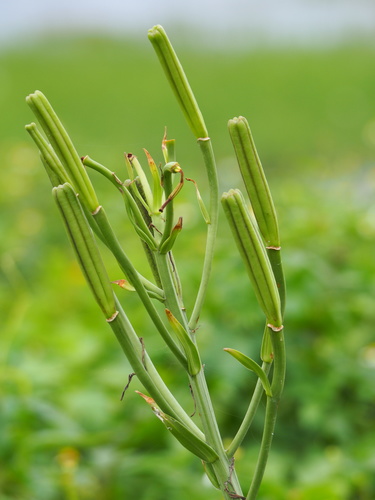
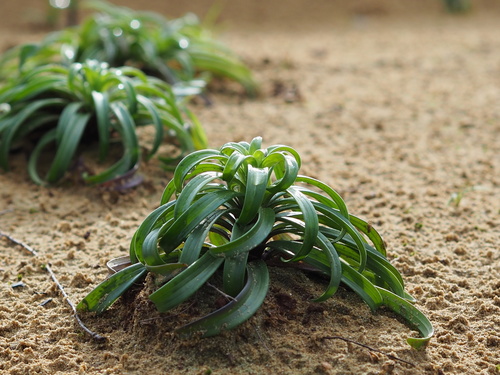
Mature plants are 45–100 cm tall; sources are few for mature spread, which is reported at about 10–50 cm. The leaves are narrow and elongated, linear to oblong-lanceolate, and green to dark green; some sources describe them as glossy and scattered or spirally arranged along the stem. The flowers are pure white, trumpet-shaped to long-tubular, usually held horizontally outward or slightly nodding, and distinctly fragrant. Sources differ on flowering time, which ranges from late spring into summer depending on origin and cultivation conditions and can also be manipulated horticulturally; the fruit is reported to be a capsule that matures later.
Light
Grow in full sun while keeping the roots or base shaded; container-grown plants may be given some shade under extremely hot sunlight.
Watering
Keep the soil evenly moist but well drained; excessive dryness and deep shade are unfavorable for growth.
Temperature and dormancy
A single source reports a minimum temperature of about -5 °C, so sources are few. It is generally rated RHS H3.
Growing medium and mounting
Well-drained loam rich in organic matter or humus is preferred, though sandy, clay, and calcareous soils are also tolerated; the soil may be acidic, neutral, or alkaline.
Propagation
Lilium longiflorum can be propagated by seed or by dividing bulbs.
Common problems
Potential pests include bulb mites, slugs, snails, aphids, potato aphids, tulip aphids, and narcissus bulb flies; young shoots may also be eaten by rabbits. It may be browsed by white-tailed deer, does not tolerate dryness, and may develop problems when grown repeatedly in the same location. It is sensitive to dryness and early frost; in cooler regions, a warm, sheltered position is preferable.
Identification
Lilium longiflorum has a bulb, upright stem, narrow elongated leaves, and large, pure white, fragrant, trumpet-shaped flowers that usually open horizontally outward; it is a stem-rooting lily.
Photos


Sources
- Wikipedia (en): Lilium longiflorum — CC BY-SA 4.0 · link
- 維基百科:鐵炮百合 — CC BY-SA 4.0 · link
- Wikipedia (ja): テッポウユリ — CC BY-SA 4.0 · link
- Wikipedia (de): Oster-Lilie — CC BY-SA 4.0 · link
- Wikipedia (es): Lilium longiflorum — CC BY-SA 4.0 · link
- NC State Plant Toolbox: Lilium longiflorum — copyright (facts only) · link
- TaiCOL 臺灣物種名錄: Lilium longiflorum — CC BY 4.0 · link
- Useful Tropical/Temperate Plants: Lilium longiflorum — CC BY-NC-SA 3.0 (facts only) · link
- RHS Plants: Lilium longiflorum — © RHS, facts only · link
- USDA PLANTS Database: Lilium longiflorum — Public domain (US Government work) · link