
leucobryum moss (Leucobryum glaucum)
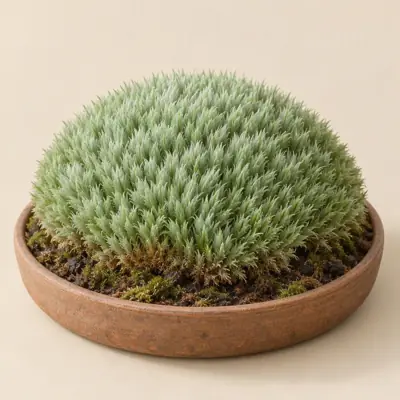
Leucobryum glaucum is a non-vascular moss that forms dense, rounded to raised, thick cushions. It is reported to be long-lived.
Overview
Leucobryum glaucum is a non-vascular moss that forms dense, rounded to raised, thick cushions. It is reported to be long-lived.
Origin and habitat
It is widely distributed across the Northern Hemisphere, with sources specifically recording Europe, Asia, North America, and Central America; it is especially common in northern acidic forests of North America and Europe, and USDA lists it as native to North America. It occurs mainly in forests, especially acidic forests and coniferous forests, and also in peatlands, wet grasslands, humus, peat, dead wood, and on silicate rocks in acidic, lime-free environments that are at least periodically moist. It is reported from temperate environments of the Northern Hemisphere.
Characteristics
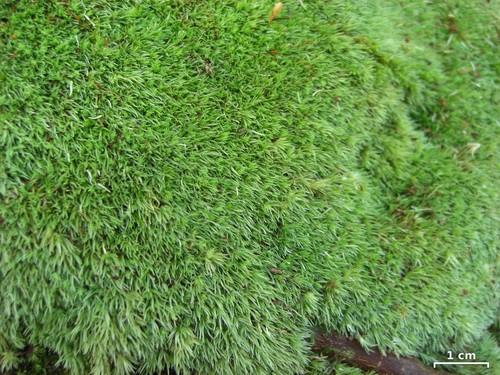
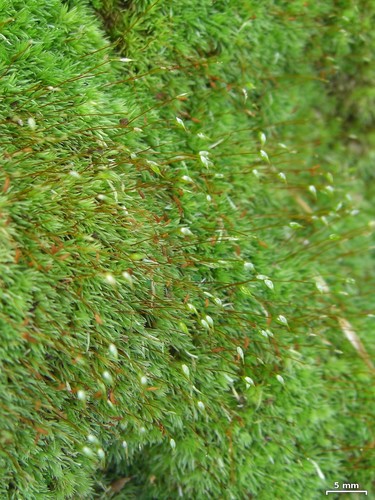
Sources differ on mature height, placing it at about 1–20 cm. A source reports a mature spread of about 10–20 cm. The densely arranged leaves are upright or somewhat directed to one side, lance-shaped and entire, with tips rolled inward into a nearly tubular form and ovate bases; sources differ in their descriptions of leaf length. It is reported to form spore capsules borne on long stalks; the capsules are inclined and curved and have capsule teeth, but they are difficult to observe and rarely form.
Watering
It is reported to suit environments that are at least periodically moist, while sexual reproduction requires moist conditions because sperm must move through water.
Growing medium and mounting
It favors acidic, lime-free, nutrient-poor substrates and occurs naturally on coarse humus, peat, dead wood, and silicate rocks.
Propagation
It is reported to reproduce vegetatively through fragmentation and broken leaves, and also by oogamous reproduction; during sexual reproduction, sperm require water for movement.
Identification
It is reported to form thick, raised, rounded cushions that are pale green when moist, become white or nearly white when dry, and are paler brown at the base.
Photos


Sources
- Wikipedia (en): Leucobryum glaucum — CC BY-SA 4.0 · link
- Wikipedia (de): Gemeines Weißmoos — CC BY-SA 4.0 · link
- Wikipedia (fr): Leucobryum glaucum — CC BY-SA 4.0 · link
- GBIF descriptions: Validated red lists of Flanders, Belgium — per dataset · link
- USDA PLANTS Database: Leucobryum glaucum — Public domain (US Government work) · link