
common duckweed (Lemna minor)
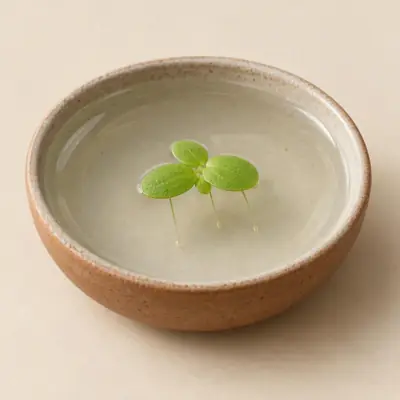
Lemna minor is a small, free-floating freshwater herbaceous aquatic plant that often forms colonies covering the water surface. Sources differ in describing its life cycle; it is described as perennial.
Overview
Lemna minor is a small, free-floating freshwater herbaceous aquatic plant that often forms colonies covering the water surface. Sources differ in describing its life cycle; it is described as perennial.
Origin and habitat
Its native range extends broadly across much of Africa, Asia, Europe, and North America; Australasia is outside its native range, and some sources explicitly record it as naturalized in Australia and New Zealand. Sources differ in their habitat descriptions, which include still or slow-moving fresh water such as ponds, lakes, waterways, rice fields, and lotus fields, as well as calm mesotrophic to eutrophic waters. It occurs mainly in temperate to some tropical regions with freshwater habitats and can grow in cool-temperate environments with relatively mild winters; sources indicate that it is generally absent from Arctic and subarctic climates.
Characteristics
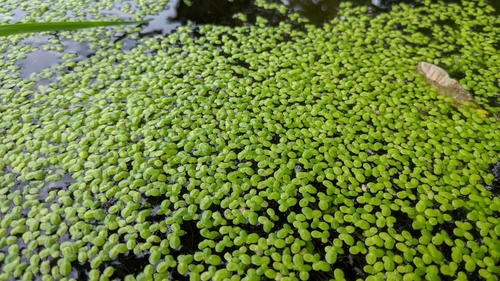
Sources differ, with limited evidence indicating a mature height of about 1–1 cm, while mature spread is 0.1–0.8 cm. It grows rapidly, reproducing mainly vegetatively and quickly forming mat-like colonies across the water surface under suitable conditions. Sources differ in describing the leaf-like fronds, which are generally elliptic to broadly elliptic and pale to bright green, with inconspicuous veins and a root hanging into the water from each mature frond. It is reported to produce very small, rare, highly reduced flowers with female and male structures; flowering is reported in summer and is rare, and fruit and seeds are also described as very small.
Light
Lemna minor grows in full sun to partial shade, with some sources indicating that it grows best with ample light. It tolerates some direct sun.
Watering
It needs to remain in fresh water, preferring still or slowly moving surfaces; it has no drought tolerance and has high water requirements.
Temperature and dormancy
Sources differ, with limited evidence indicating a minimum temperature of about 6 °C. Evidence from few sources reports an ideal temperature of about 7–25 °C. Sources differ, with limited evidence indicating a maximum temperature of about 33 °C.
Feeding
In large-scale artificial cultivation, nutrients need to be supplied and distributed evenly, with harvesting used to prevent the surface layer of plants from becoming too dense; sources also describe its fertility requirement as moderate.
Propagation
It is reported to propagate mainly vegetatively, with new fronds forming at the sides of existing fronds before separating into independent plants; propagation from seed is comparatively uncommon because flowering is rare.
Common problems
It reproduces extremely rapidly and may excessively cover the water surface under suitable conditions; the small floating plants can also be blown into piles, leaving some areas of water exposed and increasing opportunities for algal growth. It is reported to be sensitive to low temperatures and wind; low temperatures can alter growth and overwintering, while wind can gather the small free-floating plants into clusters.
Identification
The fronds float on the water surface and each has a single root; they generally have inconspicuous veins, an unwinged root sheath, a blunt root tip, and an underside that is usually neither purple nor red.
Photos


Sources
- GBIF Backbone: Lemna minor L. — CC BY 4.0 · link
- Wikipedia (en): Lemna minor — CC BY-SA 4.0 · link
- 維基百科:浮萍 — CC BY-SA 4.0 · link
- Wikipedia (ja): コウキクサ — CC BY-SA 4.0 · link
- Wikipedia (de): Kleine Wasserlinse — CC BY-SA 4.0 · link
- Wikipedia (fr): Lemna minor — CC BY-SA 4.0 · link
- Wikipedia (es): Lemna minor — CC BY-SA 4.0 · link
- GBIF descriptions: Database of Vascular Plants of Canada (VASCAN); DAISIE - Inventory of alien invasive species in Euro — per dataset · link
- NC State Plant Toolbox: Lemna minor — copyright (facts only) · link
- Wikipedia (it): Lemna minor — CC BY-SA 4.0 · link
- Wikipedia (pt): Lemna minor — CC BY-SA 4.0 · link
- Useful Tropical/Temperate Plants: Lemna minor — CC BY-NC-SA 3.0 (facts only) · link
- USDA PLANTS Database: Lemna minor — Public domain (US Government work) · link