
English lavender (Lavandula angustifolia)
Lavandula angustifolia is an aromatic, evergreen shrub to subshrub with a woody base. It is perennial.
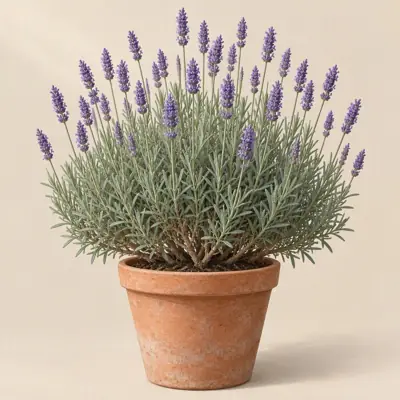
Overview
Lavandula angustifolia is an aromatic, evergreen shrub to subshrub with a woody base. It is perennial.
Origin and habitat
Sources differ on the details of its native range, describing the Mediterranean region, especially southern Europe to the western Mediterranean, and specifically mentioning Spain, France, and Italy. It is reported from dry grassy slopes, among rocks, and exposed, hot, relatively dry rocky habitats, often on calcareous soils. It is suited to a Mediterranean-like climate with wetter winters and dry summers and has some tolerance of cold and drought.
Characteristics
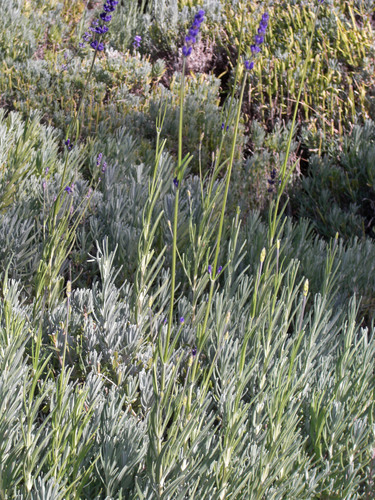
Sources differ, with the few available sources placing mature height at about 50–100 cm. A limited source reports a mature spread of about 100–150 cm. The aromatic, gray-green leaves are opposite and narrow to linear or lance-shaped, with entire margins that may roll backward; they may remain evergreen. The aromatic flowers are mainly purple, lavender-purple to blue-purple, borne in generally dense spikes at the ends of slender flower stalks; some cultivated forms have pink or white flowers, and sources differ on the flowering period, generally placing it in summer with flowering sometimes extending into autumn depending on location or growing conditions.
Light
Lavandula angustifolia grows in full sun.
Watering
Keep watering on the dry to moderate side; established plants tolerate drought, while prolonged wetness or waterlogging is unsuitable and good drainage is very important.
Temperature and dormancy
Sources differ, with the few available sources placing the minimum temperature at about -10 °C. Sources differ in their hardiness classifications. Lavandula angustifolia is frost hardy.
Growing medium and mounting
The soil must be well drained and may be sandy, loamy, or chalky; sources differ, with several favoring neutral to alkaline conditions while another indicates tolerance of acidic soil. Avoid heavy clay soil that remains wet for long periods.
Feeding
It is generally reported to need little or no fertilizer.
Propagation
It is reported to be propagated by seed, division, or stem cuttings.
Common problems
Prolonged wetness, poor drainage, or heavy clay soil can cause poor growth; in heavy clay the plant may die, and poor drainage may also cause leaf yellowing. It tolerates drought and has some cold tolerance but is unsuited to a persistently wet root environment.
Identification
Lavandula angustifolia is strongly aromatic, with conspicuous narrow gray-green leaves and purple to blue-purple flower spikes borne at the ends of slender flower stalks with few or no leaves.
Photos



Sources
- Wikipedia (en): Lavandula angustifolia — CC BY-SA 4.0 · link
- 維基百科:狹葉薰衣草 — CC BY-SA 4.0 · link
- Wikipedia (de): Echter Lavendel — CC BY-SA 4.0 · link
- Wikipedia (fr): Lavandula angustifolia — CC BY-SA 4.0 · link
- Wikipedia (es): Lavandula angustifolia — CC BY-SA 4.0 · link
- NC State Plant Toolbox: Lavandula angustifolia — copyright (facts only) · link
- Wikipedia (it): Lavandula angustifolia — CC BY-SA 4.0 · link
- Wikipedia (nl): Echte lavendel — CC BY-SA 4.0 · link
- Wikipedia (pt): Lavandula angustifolia — CC BY-SA 4.0 · link
- Useful Tropical/Temperate Plants: Lavandula angustifolia — CC BY-NC-SA 3.0 (facts only) · link
- RHS Plants: Lavandula angustifolia — © RHS, facts only · link
- USDA PLANTS Database: Lavandula angustifolia — Public domain (US Government work) · link
- Top Tropicals catalog: Lavandula angustifolia — © Top Tropicals LLC (facts only) · link