
lantana (Lantana camara)
Lantana camara is a perennial evergreen shrub whose form may be upright, trailing, spreading, or climbing, with woody branches that can form dense thickets.
Overview
Lantana camara is a perennial evergreen shrub whose form may be upright, trailing, spreading, or climbing, with woody branches that can form dense thickets.
Origin and habitat
Sources differ somewhat on the boundaries of its native range, describing it broadly as tropical America, extending from Mexico, Central America, and the Caribbean into South America. Sources describe its habitats somewhat differently, but it adapts to varied tropical and subtropical environments and is often found in open, disturbed, reasonably well-drained sites, including farmland, pasture, open ground, and slopes. It is mainly adapted to tropical and subtropical climates, prefers warmth, and is sensitive to prolonged cold and freezing.
Characteristics
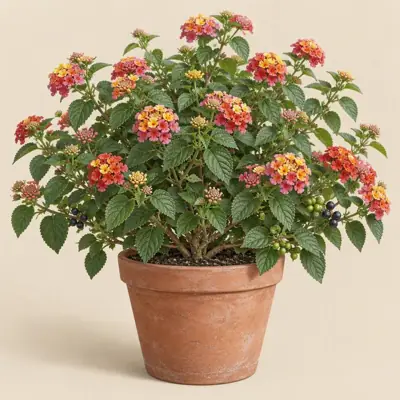
Sources differ on mature height, placing it at about 150–300 cm, while few sources report a mature spread of about 250 cm. It grows rapidly and, once established, can spread actively and form thickets. Sources differ in some leaf details, but the leaves are opposite and simple, mainly ovate to oblong-ovate, with serrated or bluntly serrated margins and rough surfaces; crushed leaves have a noticeable odor. Numerous small tubular flowers are densely clustered in head-like or nearly umbel-like inflorescences and may be yellow, orange, red, white, pink, or purple, often changing from lighter to darker colors as they age; sources differ on flowering patterns, with nearly year-round flowering described in warm regions and flowering mainly from spring through autumn or until the first frost in temperate settings, while the small fleshy drupes are described as green when immature and purple-black to black when mature, usually occurring in clusters.
Light
Lantana camara prefers strong light and full sun.
Watering
Moist, well-drained soil is suitable, although mature plants have some drought tolerance; no particular soil type is required, but poor drainage should be avoided.
Humidity and airflow
It is reported to need good airflow.
Temperature and dormancy
Few sources report an ideal temperature range of about 20–32 °C. A USDA hardiness-zone classification is reported for the plant. It is reported to tolerate brief light frost.
Growing medium and mounting
It adapts to a wide range of soils, preferring well-drained, organic-rich sandy loam while also tolerating relatively poor soil.
Propagation
It can be propagated by seed or cuttings; seed may be taken from mature fruits that have turned black and become slightly shriveled, while cuttings may be taken during vigorous growth in spring or autumn and can root after a period of time. Air layering is also reported as a propagation method.
Common problems
Its strong reproductive and spreading ability allows it to escape cultivation readily in suitable climates and form dense thickets that can displace other plants and reduce pasture or farmland productivity. It tolerates heat and has some drought tolerance but is sensitive to prolonged cold and freezing; some varieties can withstand brief light frost, while extended freezing can cause leaf drop and death of above-ground woody branches.
Identification
Branches are often four-angled and bear fine prickles or downward-curving hooks; the rough leaves have a strong odor when crushed, and the densely clustered small flowers change color as they mature, so several colors may occur within the same inflorescence.
Photos


Sources
- Wikipedia (en): Lantana camara — CC BY-SA 4.0 · link
- 維基百科:馬纓丹 — CC BY-SA 4.0 · link
- Wikipedia (ja): ランタナ — CC BY-SA 4.0 · link
- Wikipedia (de): Wandelröschen — CC BY-SA 4.0 · link
- Wikipedia (fr): Lantana camara — CC BY-SA 4.0 · link
- Wikipedia (es): Lantana camara — CC BY-SA 4.0 · link
- GBIF descriptions: The checklist of alien seed plants of D.R. Congo, based on evidence from herbarium collections; Chec — per dataset · link
- NC State Plant Toolbox: Lantana camara — copyright (facts only) · link
- Wikipedia (nl): Wisselbloem — CC BY-SA 4.0 · link
- TaiCOL 臺灣物種名錄: Lantana camara — CC BY 4.0 · link
- 農業知識入口網 植物圖鑑: Lantana camara — © MOA, facts only · link
- Useful Tropical/Temperate Plants: Lantana camara — CC BY-NC-SA 3.0 (facts only) · link
- USDA PLANTS Database: Lantana camara — Public domain (US Government work) · link
- Top Tropicals catalog: Lantana camara — © Top Tropicals LLC (facts only) · link