
Panda Plant (Kalanchoe tomentosa)
Kalanchoe tomentosa is an upright, shrubby perennial succulent whose stems gradually become woody at the base with age and may branch. It is an evergreen perennial.
Overview
Kalanchoe tomentosa is an upright, shrubby perennial succulent whose stems gradually become woody at the base with age and may branch. It is an evergreen perennial.
Origin and habitat
Kalanchoe tomentosa is native to Madagascar, with records mainly from central to east-central areas. It inhabits rocky, well-drained environments, including documented granite outcrops. It is adapted to dry, strongly sunlit environments, and its dense leaf hairs reduce transpiration and reflect some light, helping limit water loss and overheating.
Characteristics
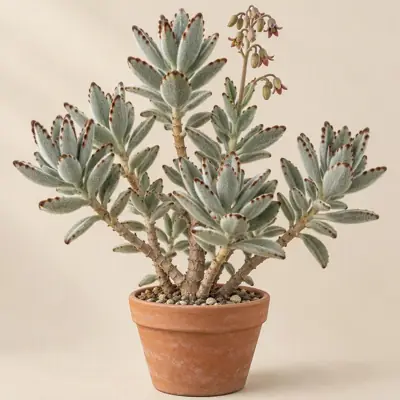
Sources differ on mature size, with height reported at about 50–100 cm and spread at about 10–50 cm; growth is slow. Sources describe the leaves differently: they are sessile, thick and fleshy, ranging in shape from obovate, ovate, and oblong to narrowly lanceolate, with dense white to gray-white hairs, often a silvery gray-green appearance, usually bluntly toothed or wavy upper margins, and reddish-brown to dark-brown coloring at the tooth tips and leaf tips; plant form varies noticeably. Sources also differ in descriptions of flowering: the small, hairy flowers are tubular to bell-shaped and borne in panicle-like inflorescences, with yellow-green, greenish-white, or yellow-brown colors that may include purple to brownish-purple tones; accounts differ on flowering season, and flowering is less common in cultivation. It stores water in its leaves and is reported to produce dry capsules containing many small seeds.
Light
Kalanchoe tomentosa grows in bright light or part shade; sources differ on exposure, describing cultivation in ample sunlight while recommending bright indirect light or some shade and avoidance of intense exposure in hot regions.
Watering
It is drought tolerant; after watering, allow the growing medium to dry before watering again, reduce watering further in winter, and avoid prolonged wetness or standing water.
Humidity and airflow
It is generally reported to prefer low humidity and need good airflow.
Temperature and dormancy
The ideal temperature range is 16–24 °C. Sources are few and differ on the lower temperature limit, with about -2 °C reported, while a single source places the upper limit at about 24 °C. Hardiness-zone accounts differ, and it is generally reported to tolerate brief light frost. Leaf hairs can reflect light and reduce overheating risk, but intense sun should be avoided in extremely hot climates because leaves may scorch.
Growing medium and mounting
Use a well-drained succulent or cactus growing medium that may contain sand or gravelly material, and avoid prolonged waterlogging. Kalanchoe tomentosa is prone to rot and needs a fast-draining mix.
Feeding
A balanced liquid fertilizer is generally reported to be suitable during the growing season.
Propagation
Kalanchoe tomentosa can be propagated by leaf cuttings, stem cuttings, offsets, or seeds; leaf and stem cuttings are suited to spring through early summer.
Common problems
Mealybugs and aphids are reported as possible pests. Insufficient light can cause elongated growth, while excess water, poor drainage, or excessive moisture can lead to poor growth or rot; intense direct sun in hot conditions can scorch the leaves. It does not tolerate severe cold or hard frost; when conditions approach freezing or frost is a risk, it should be moved to a protected environment, while intense sunlight in hot climates can also cause leaf scorch.
Identification
Distinctive features include thick, fleshy leaves densely covered with silvery-white to gray-white hairs and chocolate-brown to reddish-brown markings along the margins or at the tips, giving the whole plant a soft, velvety appearance.
Photos


Sources
- GBIF Backbone: Kalanchoe tomentosa Baker — CC BY 4.0 · link
- Wikipedia (en): Kalanchoe tomentosa — CC BY-SA 4.0 · link
- 維基百科:褐斑伽蓝 — CC BY-SA 4.0 · link
- Wikipedia (de): Kalanchoe tomentosa — CC BY-SA 4.0 · link
- Wikipedia (fr): Kalanchoe tomentosa — CC BY-SA 4.0 · link
- Wikipedia (es): Kalanchoe tomentosa — CC BY-SA 4.0 · link
- GBIF descriptions: Taxonomy and nomenclature of Kalanchoe tomentosa (Crassulaceae subfam. Kalanchooideae), a variable, — per dataset · link
- NC State Plant Toolbox: Kalanchoe tomentosa — copyright (facts only) · link
- Wikipedia (nl): Pandaplant — CC BY-SA 4.0 · link
- Wikipedia (pt): Kalanchoe tomentosa — CC BY-SA 4.0 · link
- LLIFLE Encyclopedia of living forms: Kalanchoe tomentosa — CC BY-SA · link
- RHS Plants: Kalanchoe tomentosa — © RHS, facts only · link
- Desert-Tropicals: Kalanchoe tomentosa — © Philippe Faucon (desert-tropicals.com), facts only · link
- The Succulent Plant Page: Kalanchoe (genus-level) — © R.J. Hodgkiss, facts only · link