
Kalanchoe luciae (Kalanchoe luciae)
Kalanchoe luciae is a short-stemmed, rosette-forming succulent that may grow singly or in clumps, with mature rosettes producing upright flower stalks. Sources differ in describing it as perennial or biennial; an individual rosette dies after flowering, while basal offsets usually continue growth.
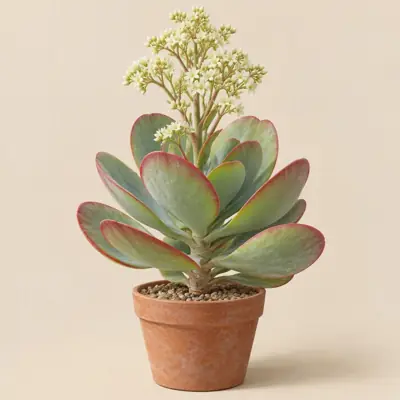
Overview
Kalanchoe luciae is a short-stemmed, rosette-forming succulent that may grow singly or in clumps, with mature rosettes producing upright flower stalks. Sources differ in describing it as perennial or biennial; an individual rosette dies after flowering, while basal offsets usually continue growth.
Origin and habitat
It is native to southern Africa, with explicit records from northeastern South Africa, Eswatini, Mozambique, and Zimbabwe. It is reported from open woodland or savanna on granite slopes. It is adapted to warm, relatively sunny, well-drained conditions and does not tolerate frost.
Characteristics
Sources differ on mature height, giving a range of about 50–250 cm, while mature spread is 10–60 cm; growth is reported to be fast. The sessile leaves are thick and flat, often obovate, spoon-shaped, or nearly round, and range from gray-green through yellow-green to bright green; they may have a grayish-white powdery coating, have entire margins, store water, and develop more pronounced red coloration with ample light or cooler conditions. Mature rosettes produce dense inflorescences of small tubular flowers, mainly recorded as pale yellow-green to pale yellow; flowering is recorded in early summer, while a commercial cultivation source describes yellow inflorescences appearing in early spring. The fruit consists of follicles containing small seeds.
Light
Kalanchoe luciae takes full sun and is grown mainly in abundant light to full sun, while indoors it is suited to a bright position. Abundant light can promote red leaf margins, but RHS recommends avoiding excessively intense direct sun during hot summers.
Watering
Use a well-drained medium and allow the soil to dry after watering before watering again, with less water in winter. During hot summers it can accept somewhat more water than some other succulents, but prolonged wetness should still be avoided.
Humidity and airflow
It is generally reported to need good airflow and to prefer low humidity.
Temperature and dormancy
A minimum growing temperature is reported, while sources differ on its hardiness-zone rating. It is generally described as frost tender; keep above freezing. It is reported to have no marked dormancy, and one specialist source gives a cold minimum of about -2 °C. It is reported to need protection from intense sunlight during hot summers.
Growing medium and mounting
It needs a fast-draining mix; a loam-based medium amended with coarse sand or gravelly material can be used, and the soil reaction may range from acidic to alkaline. It is prone to rot.
Feeding
A balanced liquid fertilizer is reported to be suitable for occasional application during the growing season.
Propagation
It can be propagated in spring or summer by separating basal plantlets or by stem cuttings, and it can also be raised from seed in spring. Recorded propagation methods include division of basal offsets, leaf cuttings, separation of basal plantlets, stem cuttings, and sowing seed.
Common problems
Possible pests include aphids and mealybugs, with scale insects occurring less often; snails may also cause permanent cosmetic damage to the leaves. Disease problems are generally limited, although leaf spot may occur. Poor drainage or prolonged wetness does not suit its cultivation needs, and insufficient light may reduce red leaf coloration. It is sensitive to frost and freezing, needs frost protection during cold periods, and is suited to warmer conditions.
Identification
Large, broad, rounded, paddle-like succulent leaves form rosettes, with the margins becoming conspicuously red under strong light or low-temperature stimulation. It is often confused with Kalanchoe thyrsiflora.
Photos


Sources
- Wikipedia (en): Kalanchoe luciae — CC BY-SA 4.0 · link
- Wikipedia (de): Kalanchoe luciae — CC BY-SA 4.0 · link
- LLIFLE Encyclopedia of living forms: Kalanchoe luciae — CC BY-SA · link
- RHS Plants: Kalanchoe luciae — © RHS, facts only · link
- The Succulent Plant Page: Kalanchoe (genus-level) — © R.J. Hodgkiss, facts only · link
- NHK みんなの趣味の園芸 植物図鑑: Kalanchoe (genus-level) — © NHK出版, facts only · link
- NC State Plant Toolbox: Kalanchoe (genus-level) — copyright (facts only) · link
- Top Tropicals catalog: Kalanchoe luciae — © Top Tropicals LLC (facts only) · link
- PUKUBOOK: Kalanchoe luciae — CC BY-NC (facts only) · link
- Kalanchoe luciae Paddle Plant [large] (mountaincrestgardens.com) — facts only (§12) · link
- Kalanchoe luciae | Giromagi cactus and succulents for sale | Buy plants online (www.giromagi.com) — facts only (§12) · link