
lavender scallops (Kalanchoe fedtschenkoi)
Kalanchoe fedtschenkoi is a perennial succulent herb to subshrub with a low to upright, branching habit; it can spread by trailing stems that may fall over and root where they contact the ground, forming new plants.
Overview
Kalanchoe fedtschenkoi is a perennial succulent herb to subshrub with a low to upright, branching habit; it can spread by trailing stems that may fall over and root where they contact the ground, forming new plants.
Origin and habitat
It is native to Madagascar, with more specific accounts placing it from the south-central to southeastern parts of the island. It occurs in dry, open sites, including bedrock or semi-desert environments in Madagascar. It is adapted to dry to semi-desert conditions but does not tolerate frost, and it can also be cultivated in tropical conditions or as an indoor plant in temperate regions.
Characteristics
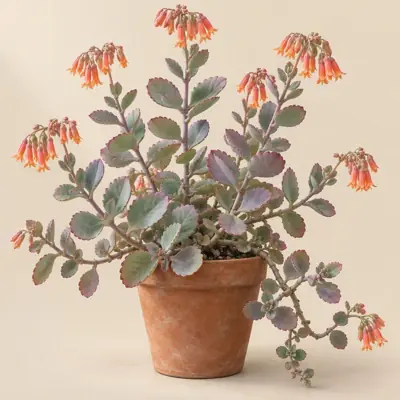
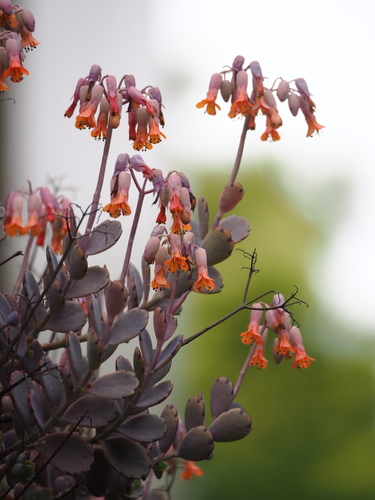
Sources differ on mature height, placing it at about 25–80 cm. A limited source base reports a mature spread of about 30–40 cm. Sources differ in their descriptions of the fleshy, hairless, waxy leaves: they are generally ovate, obovate to nearly round, may be blue-green, gray-green, pale purple or brownish yellow-green, and have rounded teeth or notches often tinged pink to reddish purple; stronger light or drought can make the red coloration more pronounced, and buds can sometimes form in the marginal notches. Sources differ on flower color, describing pendent, tubular to tubular-bell-shaped flowers in terminal corymb-like clusters, with colors ranging among orange, coral, apricot, pink-orange, yellow and red, while some also describe purple or reddish-brown flowers; flowering occurs from winter to spring. The fruit consists of clustered follicles containing many very small seeds, which become dark brown to reddish brown when mature; the plant stores water in its leaves and can expand its clumps through trailing stems that root on contact with the ground, while detached leaves may also form new plants.
Light
Sources differ between recommending bright light to full sun and, in hot conditions, bright shade; Kalanchoe fedtschenkoi takes full sun, and stronger sunlight can bring out pink to red coloration along the leaf margins.
Watering
Provide moderate water during the growing season and reduce watering in winter; the growing medium should drain well and should not remain excessively wet for long periods.
Humidity and airflow
It is generally reported to prefer low humidity.
Temperature and dormancy
A limited source base reports a cold minimum of about 5 °C. It is frost tender; keep above freezing. Sources differ in their reported USDA hardiness zones. It is reported to tolerate hot conditions well in Phoenix, though light shade is recommended there.
Growing medium and mounting
It generally needs a well-drained, fast-draining mix and should not remain persistently wet or waterlogged; it is prone to rot.
Feeding
It is reported that fertilizer can be applied during the growing period; general Kalanchoe cultivation guidance recommends a balanced fertilizer during the growing season, while other horticultural guidance uses slow-release fertilizer from spring and summer into early autumn.
Propagation
It is readily propagated from stem or leaf cuttings; trailing stems can root where they contact the ground, and the margins of fallen or damaged leaves can also produce small plants.
Common problems
In cultivated Kalanchoe, scale insects and aphids are reported as possible pests. General Kalanchoe cultivation is reported to be susceptible to powdery mildew and gray mold, with poor airflow and cool, humid conditions increasing their occurrence. Avoid prolonged wet or waterlogged conditions and reduce water in winter; the plant does not tolerate frost and is sensitive to freezing.
Identification
Kalanchoe fedtschenkoi has waxy, fleshy blue-green to pale-purple leaves with conspicuous rounded teeth or notches and margins often tinged pink or reddish purple; its stems readily fall over and root on contact with the ground, and buds can form in the leaf-margin notches.
Photos



Sources
- GBIF Backbone: Kalanchoe fedtschenkoi Raym.-Hamet & H.Perrier — CC BY 4.0 · link
- Wikipedia (en): Kalanchoe fedtschenkoi — CC BY-SA 4.0 · link
- 維基百科:玉吊钟 — CC BY-SA 4.0 · link
- Wikipedia (de): Kalanchoe fedtschenkoi — CC BY-SA 4.0 · link
- Wikipedia (fr): Kalanchoe fedtschenkoi — CC BY-SA 4.0 · link
- Wikipedia (es): Kalanchoe fedtschenkoi — CC BY-SA 4.0 · link
- GBIF descriptions: Revisiting the nomenclature and taxonomy of the Malagasy Kalanchoe fedtschenkoi, and description of — per dataset · link
- LLIFLE Encyclopedia of living forms: Kalanchoe fedtschenkoi — CC BY-SA · link
- USDA PLANTS Database: Kalanchoe fedtschenkoi — Public domain (US Government work) · link
- Desert-Tropicals: Kalanchoe fedtschenkoi — © Philippe Faucon (desert-tropicals.com), facts only · link
- The Succulent Plant Page: Kalanchoe (genus-level) — © R.J. Hodgkiss, facts only · link
- NHK みんなの趣味の園芸 植物図鑑: Kalanchoe (genus-level) — © NHK出版, facts only · link
- NC State Plant Toolbox: Kalanchoe (genus-level) — copyright (facts only) · link
- Top Tropicals catalog: Kalanchoe fedtschenkoi — © Top Tropicals LLC (facts only) · link