
devil's backbone (Kalanchoe daigremontiana)
Kalanchoe daigremontiana is an upright succulent herb or subshrub with stems that are usually unbranched or sparsely branched. Sources differ on its life cycle, describing it as perennial, ranging from biennial to perennial, or as a monocarpic perennial.
Overview
Kalanchoe daigremontiana is an upright succulent herb or subshrub with stems that are usually unbranched or sparsely branched. Sources differ on its life cycle, describing it as perennial, ranging from biennial to perennial, or as a monocarpic perennial.
Origin and habitat
Sources differ somewhat on the native range, but place Kalanchoe daigremontiana in Madagascar, with more specific accounts pointing to southwestern Madagascar, including the Fiherenana River valley and the Androhibolava Mountains. It is native to dry environments, including sandstone, rocky ground, desert, and dry scrub, and after introduction it may escape or become naturalized along roadsides, in wasteland, and in human-modified environments. It is adapted to dry conditions and tolerates drought; it has been introduced to multiple tropical and subtropical regions and is mainly grown indoors in temperate regions.
Characteristics
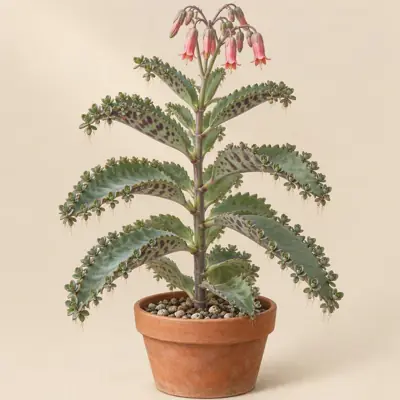
Sources differ on mature height, placing it at about 50–150 cm, while mature spread is 10–60 cm. The fleshy, opposite leaves are arranged in decussate pairs and range from ovate, lanceolate, and elongate-ovate to narrowly triangular; they are usually green to gray-green, often with purple, brown, or dark markings beneath, and have toothed or notched margins where plantlets can form. Mature plants form terminal, many-flowered inflorescences with pendent or outward-extending tubular to bell-shaped flowers, commonly gray-pink, pink, reddish purple, or purple; sources differ on flowering season, and flowering does not occur predictably every year. The flowers are reported to form follicles containing seeds.
Light
Sources differ somewhat on light conditions, supporting bright light through full sun; indoors, bright light is emphasized, while strong direct light at hot midday may be avoided and partial sun can also be suitable.
Watering
Sources differ somewhat on watering, but describe Kalanchoe daigremontiana as drought tolerant and recommend restrained watering after the growing medium has dried, with further reduction in winter and avoidance of prolonged wetness.
Humidity and airflow
It is reported to prefer low humidity and need good airflow.
Temperature and dormancy
Sources are few and differ on the minimum temperature, with about 5 °C reported; another limited-source cold minimum is about -1.1 °C. Sources differ on its USDA hardiness classification. It is frost tender; keep above freezing. It is reported to tolerate heat strongly when shaded.
Growing medium and mounting
Use a well-drained sandy or loamy growing medium; container plants can use cactus or succulent medium, while another recommendation is a loam-based medium amended with coarse sand or grit, and the plant can adapt to acidic, neutral, or alkaline soils. It needs a fast-draining mix and is reported to be prone to rot.
Feeding
A small amount of balanced liquid fertilizer can be applied during the growing season.
Propagation
Kalanchoe daigremontiana can be propagated vegetatively by plantlets that form along the leaf margins and detach on their own, as well as by shoots arising from lateral roots and by seed. Horticultural propagation can use seed or separated offsets.
Common problems
It is reported to be susceptible to mealybugs and aphids, and powdery mildew and rust may occur. Its numerous leaf-margin plantlets readily detach and root, potentially spreading quickly into nearby containers or natural environments; in some introduced areas it has naturalized and may become an invasive weed. It is sensitive to frost and freezing, so in cold regions it is suited to indoor or protected cultivation, while tolerating drought and dry soil.
Identification
A conspicuous feature is the abundance of self-rooting plantlets along the leaf margins, which readily root after detaching; the undersides of the leaves usually have purple or brown markings. Compared with Kalanchoe laetivirens, Kalanchoe daigremontiana is not uniformly green throughout; compared with Kalanchoe delagoensis, it has broader leaves; and compared with the hybrid Kalanchoe × houghtonii, its leaves are broader and their bases are more distinctly heart-shaped, auriculate, or peltate.
Photos


Sources
- GBIF Backbone: Kalanchoe daigremontiana Raym.-Hamet & H.Perrier — CC BY 4.0 · link
- Wikipedia (en): Kalanchoe daigremontiana — CC BY-SA 4.0 · link
- 維基百科:三角叶落地生根 — CC BY-SA 4.0 · link
- Wikipedia (de): Kalanchoe daigremontiana — CC BY-SA 4.0 · link
- Wikipedia (fr): Kalanchoe daigremontiana — CC BY-SA 4.0 · link
- Wikipedia (es): Kalanchoe daigremontiana — CC BY-SA 4.0 · link
- NC State Plant Toolbox: Kalanchoe daigremontiana — copyright (facts only) · link
- Wikipedia (it): Kalanchoe daigremontiana — CC BY-SA 4.0 · link
- Wikipedia (pt): Kalanchoe daigremontiana — CC BY-SA 4.0 · link
- LLIFLE Encyclopedia of living forms: Kalanchoe daigremontiana — CC BY-SA · link
- RHS Plants: Kalanchoe daigremontiana — © RHS, facts only · link
- USDA PLANTS Database: Kalanchoe daigremontiana — Public domain (US Government work) · link
- Desert-Tropicals: Kalanchoe daigremontiana — © Philippe Faucon (desert-tropicals.com), facts only · link
- The Succulent Plant Page: Kalanchoe (genus-level) — © R.J. Hodgkiss, facts only · link