
Madagascar widow's-thrill (Kalanchoe blossfeldiana)
Kalanchoe blossfeldiana is a perennial, clump-forming, upright evergreen succulent herb commonly grown indoors as a flowering potted plant.
Overview
Kalanchoe blossfeldiana is a perennial, clump-forming, upright evergreen succulent herb commonly grown indoors as a flowering potted plant.
Origin and habitat
It is native to Madagascar, with more specific horticultural and botanical sources placing its native range in northeastern or northern Madagascar. Sources differ on habitat details: it occurs in the mountains of Madagascar, and some sources describe it growing in humus-rich soil in the cooler highlands of the Tsaratanana mountains, where it forms small upright, shrubby plants. It is drought tolerant and, in cultivation, is adapted to warm conditions but does not tolerate frost or prolonged cold.
Characteristics
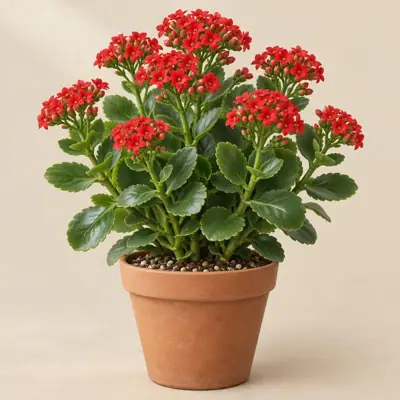
Sources differ on mature height, placing it at about 30–45 cm, while mature spread is 10–50 cm; sources also differ in describing its growth rate as slow to moderate. The fleshy, glossy, dark green to green simple leaves are generally elliptic, ovate to obovate, or oblong and opposite or nearly opposite, with mostly rounded-toothed or wavy-toothed margins; some plants can develop reddish leaf margins under strong light, and the plant stores water in its leaves. Flowers are borne in numerous clusters and are typically divided into lobes or petals; wild or early forms are mainly red, while horticultural varieties include red, orange, yellow, pink, deep pink, purple, white, and bicolored flowers, with both single and double forms. Sources differ on flowering season: natural flowering is mainly from winter through spring, while short-day control can regulate or induce flowering at other times.
Light
Sources differ on light conditions, supporting bright light through full sun and part shade; indoors, bright indirect light or a position near a window is more suitable, while shade is appropriate from intense afternoon direct sun in hot regions or summer. Flower-bud formation requires short days and long nights.
Watering
Kalanchoe blossfeldiana is drought tolerant but sensitive to waterlogging; water thoroughly after the growing medium dries, reduce watering in winter and during dormancy, and avoid prolonged wetness that can cause stem and root rot.
Humidity and airflow
It is generally reported to need moderate airflow.
Temperature and dormancy
Sources differ on temperature guidance, with a minimum of about 10 °C and an ideal range of about 18–27 °C; a single source gives a maximum of about 30 °C. Sources differ on the stated hardiness zone; the plant is frost tender and should be kept above freezing. Dormancy is generally reported to vary, and a single source gives a cold minimum of about 10 °C. High temperatures can inhibit growth, and intense direct midday sun in hot summer conditions can scorch the leaves.
Growing medium and mounting
Use a well-drained succulent or cactus growing medium; loose, porous, humus-rich soil can also be used, with gravel added to improve drainage. Kalanchoe blossfeldiana is prone to rot and needs a fast-draining mix.
Feeding
During active growth, balanced or slow-release fertilizer can be used, while feeding is stopped during dormancy; sources also describe cultivation practices that use slow-release fertilizer and liquid fertilizer according to season.
Propagation
Propagation methods include seed, stem cuttings, and leaf cuttings; tissue culture and division or offsets are also reported. Stem or shoot cuttings are reported to root within a relatively short period.
Common problems
Potential pests include aphids, scale insects, mealybugs, western flower thrips, cyclamen mites, leafrollers, fungus gnat larvae, and weevils. Reported diseases include powdery mildew, gray mold, Rhizopus-related rot, stem rot, and Pythium-related disease; cool, humid conditions and poor ventilation can increase the risk of some diseases. Overwatering readily causes stem and root rot, prolonged low light causes elongated growth, intense direct light can scorch leaves, and artificial lighting at night can disrupt short-day conditions and prevent flowering. It does not tolerate frost, snow, or cold conditions and should be moved indoors before temperatures fall in cold regions; intense midday sun in midsummer can also scorch the leaves.
Identification
Kalanchoe blossfeldiana can be recognized by its fleshy, glossy evergreen leaves, clumping habit, and abundant clusters of brightly colored flowers at the ends of branches; it is a typical short-day flowering plant.
Photos


Sources
- Wikipedia (en): Kalanchoe blossfeldiana — CC BY-SA 4.0 · link
- 維基百科:长寿花 — CC BY-SA 4.0 · link
- Wikipedia (ja): ベニベンケイ — CC BY-SA 4.0 · link
- Wikipedia (de): Kalanchoe blossfeldiana — CC BY-SA 4.0 · link
- Wikipedia (fr): Kalanchoe blossfeldiana — CC BY-SA 4.0 · link
- Wikipedia (es): Kalanchoe blossfeldiana — CC BY-SA 4.0 · link
- GBIF descriptions: Manual of the Alien Plants of Belgium; Lista de especies de plantas exóticas y trasplantadas de Colo — per dataset · link
- NC State Plant Toolbox: Kalanchoe blossfeldiana — copyright (facts only) · link
- Wikipedia (it): Kalanchoe blossfeldiana — CC BY-SA 4.0 · link
- Wikipedia (nl): Kalanchoe blossfeldiana — CC BY-SA 4.0 · link
- Wikipedia (pt): Flor-da-fortuna — CC BY-SA 4.0 · link
- TaiCOL 臺灣物種名錄: Kalanchoe blossfeldiana — CC BY 4.0 · link
- 農業知識入口網 植物圖鑑: Kalanchoe blossfeldiana — © MOA, facts only · link
- LLIFLE Encyclopedia of living forms: Kalanchoe blossfeldiana — CC BY-SA · link