
Berlandier's nettlespurge (Jatropha cathartica)
Jatropha cathartica is a perennial herb with a tuberous root. It is deciduous, becoming dormant in winter and losing its leaves and above-ground stems.
Overview
Jatropha cathartica is a perennial herb with a tuberous root. It is deciduous, becoming dormant in winter and losing its leaves and above-ground stems.
Origin and habitat
Sources differ on its native range, describing it from Texas in the United States and northeastern Mexico, with Coahuila, Nuevo León, and Tamaulipas specifically recorded in Mexico. It grows scattered in scrub in hot, arid areas, mainly on clay soils, in environments that often experience prolonged periods without rain.
Characteristics
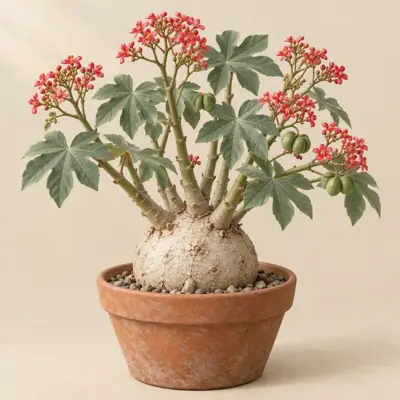
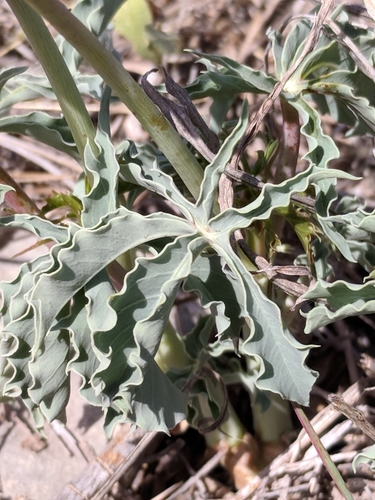
It is reported to grow slowly and has a swollen root. Sources differ in describing the deciduous leaves, which are gray-green to green, palmate, and deeply lobed. The bright pink to poppy-red flowers occur in loose inflorescences at the ends of long flower stalks, and flowering may occur through the growing season but is concentrated mainly in summer. The fruit is a green, pea-like, lobed capsule containing seeds; sources differ on mature height, with the limited source giving a range of about 0–30 cm, while the tuberous root can become thick and tall and cultivated branches can grow long.
Light
It can grow in sun or shade; indoors, it can be placed by a bright window.
Watering
Use a well-drained medium and allow it to dry between waterings; the plant tolerates prolonged drought and is dormant in winter. It is generally recommended that, while in leaf, water when the mix has dried.
Temperature and dormancy
A limited source reports a minimum of about 0 °C; it is generally described as frost tender and should be kept above freezing. A limited source likewise gives a cold minimum of about 0 °C. It drops its leaves and goes dormant, with dormancy triggered by cold.
Growing medium and mounting
For containers, use a well-drained succulent medium or general plant mix; in the wild it grows mainly on clay. It is generally reported to need a fast-draining mix.
Propagation
It is reported to be propagated by seeds or cuttings.
Common problems
In cold, wet conditions it is prone to rot, and the stems may become very soft and mushy. It tolerates drought but is sensitive to cold, wet conditions.
Identification
Jatropha cathartica has a large, nearly spherical, pale whitish woody tuberous root that is underground in the wild but may be exposed above the surface in pots, together with deeply lobed palmate leaves and pink to red flowers.
Photos


Sources
- Wikipedia (en): Jatropha cathartica — CC BY-SA 4.0 · link
- Wikipedia (de): Jatropha cathartica — CC BY-SA 4.0 · link
- LLIFLE Encyclopedia of living forms: Jatropha cathartica — CC BY-SA · link
- USDA PLANTS Database: Jatropha cathartica — Public domain (US Government work) · link
- PUKUBOOK: Jatropha cathartica — CC BY-NC (facts only) · link