
Arabian jasmine (Jasminum sambac)
Jasminum sambac is an evergreen woody shrub that may grow upright, climb, or take a semi-vining form. It is reported to be perennial.
Overview
Jasminum sambac is an evergreen woody shrub that may grow upright, climb, or take a semi-vining form. It is reported to be perennial.
Origin and habitat
Sources differ on its native range: India is regarded as its main native area, while some sources also include Bhutan. It occurs in warm regions, with records of wild or cultivated plants from lowlands to mountainous areas. It is suited to warm tropical and subtropical environments, is widely cultivated in warm regions, and has low cold tolerance.
Characteristics
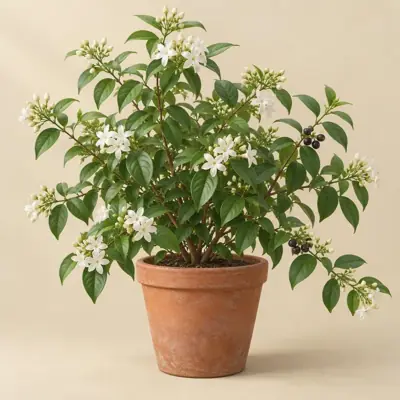
Sources differ on mature height, placing it at about 50–300 cm; the few available sources report a mature spread of about 50–100 cm. It is generally reported to grow quickly; its simple leaves are usually opposite but may occur in whorls, range from ovate to elliptic or nearly round, have entire margins, and are mostly smooth-surfaced. Sources differ in their descriptions of the flowers and flowering period: the flowers are white and strongly fragrant, commonly borne in terminal clusters or cymes, with cultivated forms ranging from single to double and many-petaled, while flowering can continue for a long period in warm conditions and may be nearly year-round in tropical areas. The fruit is a spherical berry that becomes purplish black to black when mature.
Light
Jasminum sambac grows in bright light to partial sun and can accept full sun or partial shade; indoors, bright light is suitable while excessively intense exposure should be avoided.
Watering
During active growth it prefers a moist but well-drained medium, with more frequent watering in hot summers and reduced watering in winter.
Temperature and dormancy
Sources differ, with limited evidence suggesting a lower temperature of about 10 °C, while an upper temperature of 35 °C is reported. It is generally reported to suit USDA hardiness zones and to tolerate brief light frost.
Growing medium and mounting
It prefers moist but well-drained soil, particularly light soil rich in organic matter; loam with a neutral pH is also recommended.
Feeding
During active growth, low-nitrogen fertilizer may be applied regularly; fertilizing should be avoided in winter and when temperatures exceed the stated high-temperature threshold.
Propagation
Sources differ, but propagation is mainly by cuttings and may also use layering or air layering; cultivated plants often do not set seed, so vegetative propagation is commonly used.
Common problems
It is reported to be susceptible to aphids, scale insects, mealybugs, and greenhouse red spider mites. It is reported to be susceptible to honey-fungus-related disease, although this is described as uncommon. Low temperatures may cause leaf drop, frost damage to branches, or bud drop, while excessive heat may reduce flowering. It is cold- and frost-sensitive; in cold regions it generally needs to be moved indoors or into a greenhouse for winter and can tolerate only occasional light frost.
Identification
Jasminum sambac is an evergreen woody plant that may climb or vine, with strongly fragrant white flowers that often open at night and simple rather than pinnate leaves.
Photos


Sources
- Wikipedia (en): Jasminum sambac — CC BY-SA 4.0 · link
- 維基百科:茉莉花 — CC BY-SA 4.0 · link
- Wikipedia (ja): マツリカ — CC BY-SA 4.0 · link
- Wikipedia (de): Arabischer Jasmin — CC BY-SA 4.0 · link
- Wikipedia (fr): Jasminum sambac — CC BY-SA 4.0 · link
- GBIF descriptions: Lista de especies de plantas exóticas y trasplantadas de Colombia; Catálogo de Plantas y Líquenes de — per dataset · link
- 農業知識入口網 植物圖鑑: Jasminum sambac — © MOA, facts only · link
- Useful Tropical/Temperate Plants: Jasminum sambac — CC BY-NC-SA 3.0 (facts only) · link
- RHS Plants: Jasminum sambac — © RHS, facts only · link
- USDA PLANTS Database: Jasminum sambac — Public domain (US Government work) · link
- Top Tropicals catalog: Jasminum sambac — © Top Tropicals LLC (facts only) · link