
rabbitear iris (Iris laevigata)
Iris laevigata is a rhizomatous, clump-forming perennial herb commonly found beside water and in wetlands.
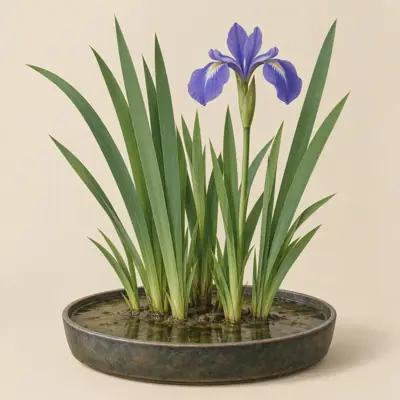
Overview
Iris laevigata is a rhizomatous, clump-forming perennial herb commonly found beside water and in wetlands.
Origin and habitat
Sources differ in their accounts of its native range, describing it as occurring in temperate Asia, including Siberia and the Russian Far East, China, the Korean Peninsula, and Japan. Its habitats include wetlands, marshes, wet meadows, ponds, shallow areas of still water, and the banks of lakes, rivers, and streams; it can grow in very wet or temporarily flooded soil. It is a temperate Asian plant suited to temperate water gardens, wetlands, and pond margins.
Characteristics
Sources differ on mature height, giving a range of about 25–100 cm. Few sources report a mature spread of about 10–50 cm. The leaves are upright and sword-shaped and may equal or exceed the flower stems in length; they lack a conspicuously prominent strong midrib and form clumps. Flowers are commonly blue, purple, or blue-purple, while horticultural forms may be white, pink, or variously patterned; typical outer tepals have white to pale-yellow markings near the base or center, and sources differ on the flowering period, generally placing it from late spring to early summer with possible continued or repeat flowering under some cultivated conditions.
Light
Full sun is preferred, though partial shade is tolerated, and ample sunlight supports flowering.
Watering
Iris laevigata needs consistently moist to wet conditions and is particularly suited to pond edges, stream margins, and shallow water; it can also be grown in suitably moist soil.
Growing medium and mounting
Deep, humus-rich, moist to wet soil is suitable; clay or loam may be used, with acidic to neutral conditions preferred and some tolerance of alkaline or calcareous conditions.
Propagation
It can be propagated by seed or division; seed can be grown under the stated peat-based, frequently watered conditions, though germination may be uneven and take a highly variable length of time, while division can be carried out from midsummer to early autumn.
Common problems
Slugs, snails, and iris sawfly may cause damage. It is reported to be susceptible to aphid-transmitted viruses, bacterial soft rot, and grey mould. Seed germination can be highly variable and uneven, and growing conditions without sufficient water depart from the plant's preferred conditions.
Identification
It is reported to depend more strongly on wet or shallow-water conditions than some other irises and to have leaves lacking a conspicuous strong midrib; a white line or white to pale-yellow marking at the base of the outer tepals can help distinguish it from other common irises.
Photos


Sources
- Wikipedia (en): Iris laevigata — CC BY-SA 4.0 · link
- 維基百科:燕子花 — CC BY-SA 4.0 · link
- Wikipedia (ja): カキツバタ — CC BY-SA 4.0 · link
- Wikipedia (de): Asiatische Sumpf-Schwertlilie — CC BY-SA 4.0 · link
- Wikipedia (fr): Iris laevigata — CC BY-SA 4.0 · link
- NC State Plant Toolbox: Iris laevigata — copyright (facts only) · link
- RHS Plants: Iris laevigata — © RHS, facts only · link
- USDA PLANTS Database: Iris laevigata — Public domain (US Government work) · link