
Narrowleaf Morning Glory (Ipomoea bolusiana)
Ipomoea bolusiana is a perennial dwarf shrub or caudiciform plant with a swollen root, producing one to several slender upright or trailing stems that become woody at the base. It is reported to be perennial.
Overview
Ipomoea bolusiana is a perennial dwarf shrub or caudiciform plant with a swollen root, producing one to several slender upright or trailing stems that become woody at the base. It is reported to be perennial.
Origin and habitat
Sources differ on its native range, describing southern Africa and Madagascar and further listing Botswana, Mozambique, Angola, Namibia, Tanzania, Zambia, and Zimbabwe. It is reported from open woodland, savanna, grassland with scattered shrubs, and rocky or sandy soils. Its distribution includes open woodland, savanna, and grassland environments from southern Africa into parts of East Africa and Madagascar.
Characteristics
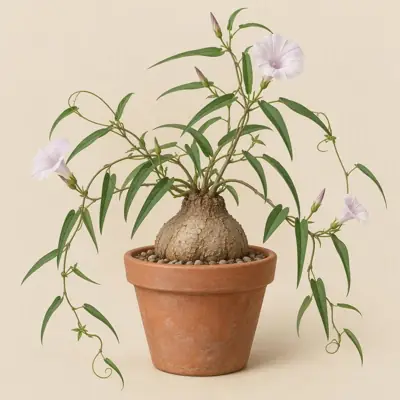
With few sources available, mature height is reported at about 20–300 cm. The leaves are relatively widely spaced, narrow, and covered with fine silvery hairs, and are deeply palmately divided into very narrow linear to threadlike lobes, while another source describes the lobes as lance-shaped. It is reported to produce large pink trumpet-shaped flowers, often with darker pink stripes, and to flower in summer. It is reported to have a swollen root and stems that can become long.
Light
It is reported to need abundant sunlight while the swollen root itself should be shaded.
Watering
During growth, it is reported to need regular but not excessive watering, allowing the soil to become drier before each watering; after flowering in summer, watering is gradually stopped as the stems dry, and resumed when the stems begin growing again in late winter. It is generally recommended that while in leaf, water when the mix has dried, and withhold water while leafless.
Temperature and dormancy
With few sources available, the reported minimum is about 0 °C. It is reported to be frost tender and should be kept above freezing. It is reported to drop its leaves and go dormant, while the dormancy trigger is not known. It is reported to have low heat tolerance.
Growing medium and mounting
It is reported to need a well-drained medium, with a mixture of cactus medium and general potting soil recommended by the source. The swollen root is generally kept mostly exposed above the soil surface or placed on the surface to root on its own; this is reported to reduce the chance of rot but result in slower growth. It is reported to need a fast-draining mix.
Common problems
Overwatering is reported to cause rot of the swollen root; exposing more of the root above the soil surface may reduce this risk but may also slow growth. The source advises avoiding high summer heat and shading the swollen root.
Identification
Ipomoea bolusiana has a conspicuously swollen root, usually exposed above ground and nearly spherical to somewhat spindle-shaped, together with slender stems, narrow deeply palmately divided leaves, and large pink trumpet-shaped flowers.
Photos

