
buzzy lizzy (Impatiens walleriana)
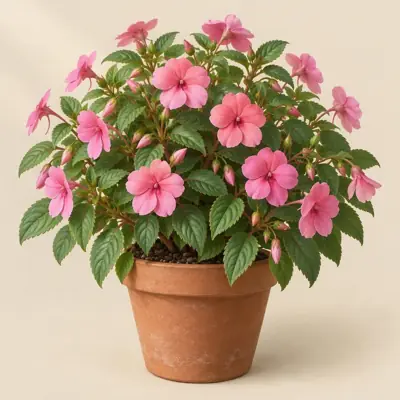
Impatiens walleriana is a herbaceous plant with somewhat fleshy stems and leaves, and cultivated plants often form dense clumps or mounds. It is inherently a perennial herb that can persist in frost-free or tropical environments, but it is commonly grown as an annual in temperate climates and ordinary flower beds.
Overview
Impatiens walleriana is a herbaceous plant with somewhat fleshy stems and leaves, and cultivated plants often form dense clumps or mounds. It is inherently a perennial herb that can persist in frost-free or tropical environments, but it is commonly grown as an annual in temperate climates and ordinary flower beds.
Origin and habitat
Sources differ in details of its native range in East Africa: the core range extends from Kenya south to Mozambique, while more detailed accounts also include Tanzania, Zimbabwe, and southern Malawi. Sources differ in their descriptions of its habitat, which includes moist tropical settings such as damp shaded places, moist rocky areas, and coastal and montane rainforests; naturalized plants also occur in shaded woodland environments in Taiwan. It is adapted to warm, humid, frost-free climates, while its native range also includes East African highland environments; in colder regions it is usually grown as an annual.
Characteristics
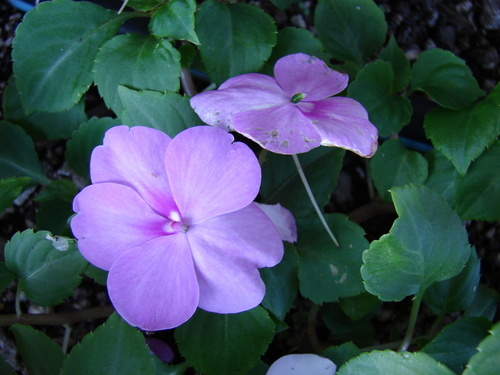
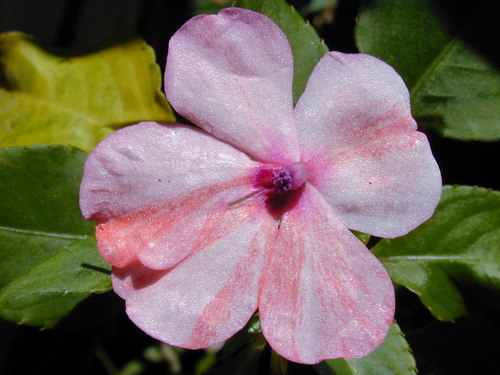
Sources differ on mature height, placing it at about 15–60 cm, while limited source evidence reports a mature spread of about 10–50 cm; growth is generally reported to be fast. Sources differ in descriptions of the leaves: they are simple and mainly alternate, sometimes opposite on the upper plant, range from ovate or broadly elliptic to lanceolate, have toothed margins, and may be green to dark green with occasional variegation, bronze tones, or pink to red undersides. The abundant, bilaterally symmetrical, spurred flowers usually have petals and may be white, pink, deep pink, red, orange, or purple, with bicolored and double-flowered cultivated forms also occurring; sources differ on the flowering period, which mainly extends from spring through autumn and can last longer under suitable climate and growing conditions. The fruit is a spindle-shaped capsule that suddenly splits open after slight stimulation when mature, scattering its seeds.
Light
Partial shade to shade is suitable, though the plant can also accept sun; in full sun it requires an adequate water supply, while information from Taiwan indicates tolerance of low light but not intense exposure and favors partial shade during hot weather.
Watering
It needs a steady water supply and is suited to moist but well-drained growing medium; it does not tolerate drought, and drying should especially be avoided during hot conditions or stronger sun exposure.
Humidity and airflow
It is generally reported to need good airflow.
Temperature and dormancy
Limited source evidence places the minimum temperature at around 10 °C.
Growing medium and mounting
It is suited to well-drained soil or growing medium that retains moisture, including loam, sandy, clay, or calcareous soils. It tolerates a broad soil pH range, while another source recommends a slightly acidic growing medium and avoiding excessive salinity.
Propagation
It can be propagated from seed or stem cuttings; cuttings root readily and can also be rooted in water. An agricultural knowledge source recommends using stem sections for cuttings, keeping them moist until they root.
Common problems
Known diseases include impatiens downy mildew, southern bacterial wilt, and southern blight-type problems of herbaceous ornamentals; impatiens downy mildew has severely affected cultivation in multiple areas. Dryness, intense exposure, and excessive heat can impair growth, while the plant's soft tissues also make it relatively susceptible to physical damage. It does not tolerate frost or very low temperatures and usually cannot persist outdoors as a perennial in temperate climates; it is also sensitive to heat and dryness, and excessive heat can make survival through midsummer difficult in Taiwan's lowlands.
Identification
Impatiens walleriana has soft, somewhat fleshy growth, abundant spurred flowers, and mature capsules that burst to scatter seeds; its soft plant parts are readily damaged.
Photos


Sources
- Wikipedia (en): Impatiens walleriana — CC BY-SA 4.0 · link
- 維基百科:苏丹凤仙花 — CC BY-SA 4.0 · link
- Wikipedia (ja): アフリカホウセンカ — CC BY-SA 4.0 · link
- Wikipedia (de): Fleißiges Lieschen — CC BY-SA 4.0 · link
- Wikipedia (fr): Impatiens walleriana — CC BY-SA 4.0 · link
- Wikipedia (es): Impatiens walleriana — CC BY-SA 4.0 · link
- NC State Plant Toolbox: Impatiens walleriana — copyright (facts only) · link
- TaiCOL 臺灣物種名錄: Impatiens walleriana — CC BY 4.0 · link
- 農業知識入口網 植物圖鑑: Impatiens walleriana — © MOA, facts only · link
- RHS Plants: Impatiens walleriana — © RHS, facts only · link
- USDA PLANTS Database: Impatiens walleriana — Public domain (US Government work) · link