
mountain hydrangea, tea of heaven (Hydrangea serrata)
Hydrangea serrata is a deciduous shrub with a compact, rounded to clumping habit. It is a perennial woody plant that sheds its leaves in winter.
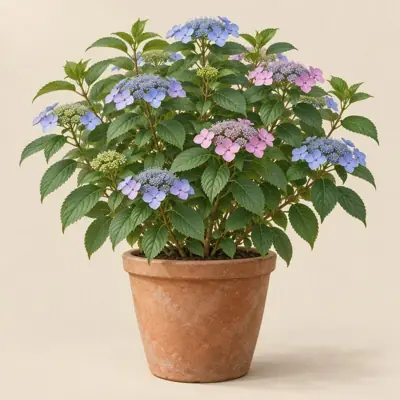
Overview
Hydrangea serrata is a deciduous shrub with a compact, rounded to clumping habit. It is a perennial woody plant that sheds its leaves in winter.
Origin and habitat
Sources differ in describing its native range as mountainous areas of Japan and Korea. Its habitat includes mountain woodland and moist stream banks, with woodland habitat also reported from Japan. It prefers cooler growing conditions where the roots do not dry out; in suitable climates it can grow in sun to partial shade, while in hot or low-rainfall areas it is best protected from direct sunlight during the hottest part of the day.
Characteristics
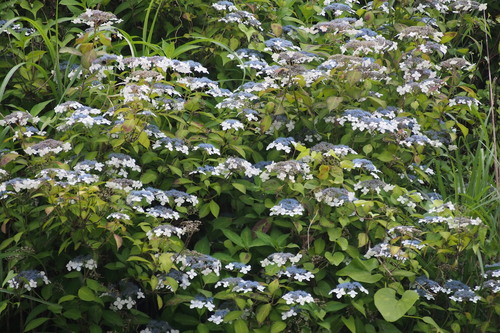
Sources differ on mature height, giving a range of about 100–200 cm, while mature spread is 100–150 cm. Growth is reported to be relatively substantial annually, while the thin, serrated leaves range from green to dark green and from narrowly ovate or ovate to elliptic or oblong; some plants develop conspicuous autumn leaf color. The inflorescences may be flat, domed, or lacecap-like, with smaller fertile flowers in the center and larger, conspicuous sterile flowers around them; flowers may be blue, pink, lilac, red, or white, and some flower colors change with soil pH. Flowering is mainly from mid- to late summer, although some sources describe it more broadly as extending from summer into autumn.
Light
Partial sun or bright shade is preferred; full sun can be tolerated when the soil remains consistently moist, while strong afternoon sun is best avoided in hot areas.
Watering
Keep the soil moist but well drained and do not allow the roots to dry out; a steady summer water supply is especially important in full sun and hot conditions.
Temperature and dormancy
The stated minimum temperature is -25 °C. It is reported to have a defined USDA hardiness rating, with protective measures allowing cultivation under colder hardiness conditions.
Growing medium and mounting
Fertile, moist but well-drained soil is preferred, and the plant can grow in loam and clay and adapt to acidic, neutral, or alkaline soils, though shallow calcareous soil may cause yellowing. Soil pH affects flower color in some varieties, tending toward blue in acidic soil and pink in neutral to alkaline soil.
Propagation
Propagation can be by seed, softwood or semi-ripe cuttings, mature hardwood cuttings, or layering. Seed can be surface-sown in a greenhouse in spring, softwood cuttings are generally taken from early summer through summer, and hardwood cuttings are taken in autumn or winter.
Common problems
Potential pests include aphids, capsid bugs, red spider mites, stem and bulb nematodes, weevils, and scale insects, with aphids mentioned by multiple sources. Potential diseases include powdery mildew, leaf spot, bud blight, bacterial wilt, gray mold, and diseases associated with Armillaria. Dry soil or hot, strong sunlight may cause leaves and flowers to fade prematurely or scorch, shallow calcareous soil may cause yellowing, and severe winter cold may kill many flower buds and reduce flowering in the following season. Dormant plants are fairly cold-hardy, but new spring growth is vulnerable to late frost; severe winter cold may kill flower buds or even above-ground growth, while hot areas call for protection from strong sun and maintenance of summer moisture.
Identification
Compared with Hydrangea macrophylla, Hydrangea serrata is usually smaller and more compact, with smaller leaves and flowers; serrated leaves and inflorescences composed of small fertile flowers and larger sterile flowers are distinguishing features.
Photos


Sources
- Wikipedia (en): Hydrangea serrata — CC BY-SA 4.0 · link
- Wikipedia (ja): ヤマアジサイ — CC BY-SA 4.0 · link
- Wikipedia (es): Hydrangea serrata — CC BY-SA 4.0 · link
- NC State Plant Toolbox: Hydrangea serrata — copyright (facts only) · link
- Useful Tropical/Temperate Plants: Hydrangea serrata — CC BY-NC-SA 3.0 (facts only) · link
- RHS Plants: Hydrangea serrata — © RHS, facts only · link