
oakleaf hydrangea (Hydrangea quercifolia)
Hydrangea quercifolia is a perennial deciduous woody plant that grows as an upright to spreading, multi-stemmed, clump-forming shrub and can produce shoots from underground runners to form colonies.
Overview
Hydrangea quercifolia is a perennial deciduous woody plant that grows as an upright to spreading, multi-stemmed, clump-forming shrub and can produce shoots from underground runners to form colonies.
Origin and habitat
It is native to the southeastern United States, with accounts extending across parts of the region and some sources extending its range into eastern Texas. In its natural habitat it occurs in woodlands, understories, along streams and rivers, on forested and steep slopes, and around rocky outcrops, often in well-drained soils; it can occur on calcareous substrates as well as deep alluvial soils. It favors relatively warm conditions but tolerates some cold, and its natural habitats commonly provide understory light and moderate moisture.
Characteristics
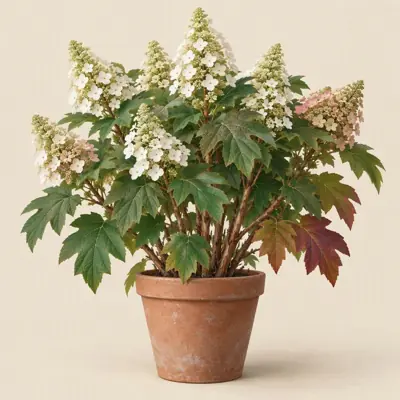
Sources differ on mature height, placing it at about 100–200 cm, while mature spread is 150–250 cm. It is reported to grow quickly and has large, coarse, pointed-lobed leaves resembling oak leaves, with green to dark green upper surfaces and undersides that may be silvery white or covered in white hairs; the foliage later turns red, reddish brown, bronze, or purple. White flowers are borne in upright, conical to pyramidal panicles containing conspicuous sterile flowers and smaller fertile flowers; as they age, the flowers may turn pink and then brown, and they are lightly fragrant. Sources differ on flowering time, with the main flowering period described as mid- to late spring through early summer; the fruit is a dry, dehiscent capsule that is green after pollination and turns brown at maturity, with a persistent stigma and numerous small seeds.
Light
It can grow in full sun to partial shade, with partial shade being suitable; in full sun, the soil needs to retain adequate moisture, while prolonged strong direct summer sunlight may scorch the leaves.
Watering
It prefers moderate, consistent moisture and moist but well-drained soil, and does not favor prolonged dryness; container-grown plants need regular watering during active growth, with less water and drier conditions after leaf fall.
Temperature and dormancy
Published sources describe it as hardy across a broad range of conditions without complete agreement on the precise classifications. It is reported to be frost hardy.
Growing medium and mounting
It prefers organic-rich, well-drained soil with moderate moisture and can adapt to clay, loam, and sandy soils; sources differ on soil reaction, with horticultural information favoring acidic to neutral conditions while natural-distribution information also records it on calcareous or mildly alkaline substrates.
Feeding
It can be fed occasionally; another source recommends feeding before new growth begins in early spring and again in midsummer.
Propagation
It can be propagated from softwood cuttings, and seeds can also germinate when kept continuously from drying out after sowing.
Common problems
Potential pests include aphids, spider mites, capsid bugs, hydrangea scale, and weevils. Leaf spot or leaf blight diseases, powdery mildew, and gray mold may occur, while Armillaria-related disease is less common. Prolonged strong direct summer sunlight can scorch leaves, excessive dryness may affect growth or flowering, and pruning too late may remove the following year's flower buds. It is sensitive to prolonged direct sunlight during hot summers, while sources differ in their descriptions of its cold tolerance.
Identification
Key identifying features are large, lobed, oak-like leaves, white panicles, and mature branches with reddish-brown to cinnamon-colored peeling bark.
Photos


Sources
- Wikipedia (en): Hydrangea quercifolia — CC BY-SA 4.0 · link
- Wikipedia (ja): カシワバアジサイ — CC BY-SA 4.0 · link
- Wikipedia (de): Eichenblättrige Hortensie — CC BY-SA 4.0 · link
- Wikipedia (fr): Hydrangea quercifolia — CC BY-SA 4.0 · link
- Wikipedia (es): Hydrangea quercifolia — CC BY-SA 4.0 · link
- NC State Plant Toolbox: Hydrangea quercifolia — copyright (facts only) · link
- RHS Plants: Hydrangea quercifolia — © RHS, facts only · link
- USDA PLANTS Database: Hydrangea quercifolia — Public domain (US Government work) · link
- Top Tropicals catalog: Hydrangea quercifolia — © Top Tropicals LLC (facts only) · link