
wild hydrangea (Hydrangea arborescens)
Hydrangea arborescens is a perennial, deciduous, multi-stemmed shrub with a rounded, clumping habit.
Overview
Hydrangea arborescens is a perennial, deciduous, multi-stemmed shrub with a rounded, clumping habit.
Origin and habitat
It is native to North America, mainly the eastern United States, with records extending from southern New York to Florida and west to eastern Oklahoma and southeastern Kansas. It commonly occurs in eastern deciduous forest understories, wooded slopes, stream and river banks, ravines, bases of cliffs, and along woodland roads, generally in habitats with some moisture, though it also occurs on rocky or gravelly slopes. It is cold tolerant and can also grow in warmer climates; its natural habitats are generally shaded and well supplied with moisture.
Characteristics
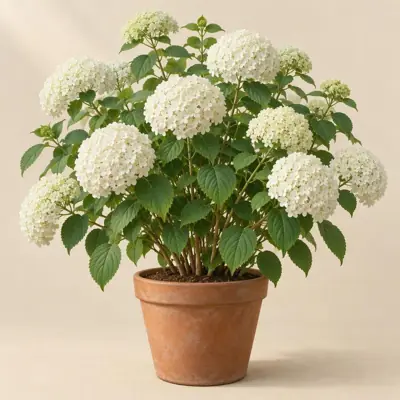
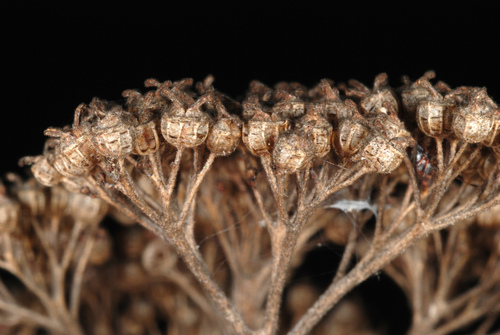
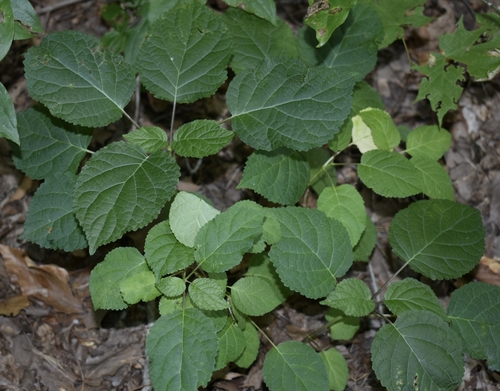
Sources differ on mature size, with height reported at about 200–300 cm and spread at about 91–152 cm. The opposite, simple leaves are mainly ovate to broadly ovate, with serrated margins; they are green, range from hairless to finely hairy beneath, and are shed in winter. Sources differ in their descriptions of the flower clusters: the species usually has small fertile flowers in the center and showier sterile flowers around them, although the sterile flowers may be absent, while 'Annabelle' can form large, nearly spherical, creamy-white flower clusters; sources also differ on the specific flowering period, which is mainly from late spring through summer. The mature fruit is reported to be a ridged, brown, woody capsule containing many tiny seeds, and one source reports that fruits form abundantly and can persist into winter.
Light
Partial sun or partial shade is preferred, although full sun is also suitable when the soil can be kept consistently moist.
Watering
Keep the soil moist but well drained and avoid prolonged drying of the roots; consistent moisture is especially important in full sun.
Temperature and dormancy
Hydrangea arborescens is frost hardy.
Growing medium and mounting
Moist but well-drained soil is suitable, including loam, clay, humus-rich soil, and rocky or gravelly soil. Acidic to neutral soils are generally suitable, while sources differ in also reporting tolerance of slightly alkaline or alkaline soils.
Propagation
It can be propagated by layering, seed, or stem cuttings; softwood cuttings can be taken in early summer and hardwood cuttings in winter.
Common problems
Possible pests include aphids, mites, scale insects, capsid bugs, and vine weevils. The species is reported to be particularly susceptible to disease caused by Armillaria. Heavy pruning that promotes especially large flower clusters can leave the supporting stems bending or drooping after heavy rain, while dry roots can also impair growth. It is generally cold tolerant, but large flower clusters are reported to make branches bend or droop under heavy rainfall, and consistent soil moisture is needed in strong sun.
Identification
The stem bark is reported to peel continuously in multiple thin layers, giving rise to the English common name sevenbark, and the plant can rapidly form colonies through runners. 'Annabelle' is reported to be distinguished by large, nearly spherical, pale flower clusters.
Photos


Sources
- Wikipedia (en): Hydrangea arborescens — CC BY-SA 4.0 · link
- Wikipedia (de): Wald-Hortensie — CC BY-SA 4.0 · link
- Wikipedia (fr): Hydrangea arborescens — CC BY-SA 4.0 · link
- Wikipedia (es): Hydrangea arborescens — CC BY-SA 4.0 · link
- GBIF descriptions: Database of Vascular Plants of Canada (VASCAN); DAISIE - Inventory of alien invasive species in Euro — per dataset · link
- NC State Plant Toolbox: Hydrangea arborescens — copyright (facts only) · link
- Useful Tropical/Temperate Plants: Hydrangea arborescens — CC BY-NC-SA 3.0 (facts only) · link
- RHS Plants: Hydrangea arborescens — © RHS, facts only · link
- USDA PLANTS Database: Hydrangea arborescens — Public domain (US Government work) · link