
Hoya retusa (Hoya retusa)
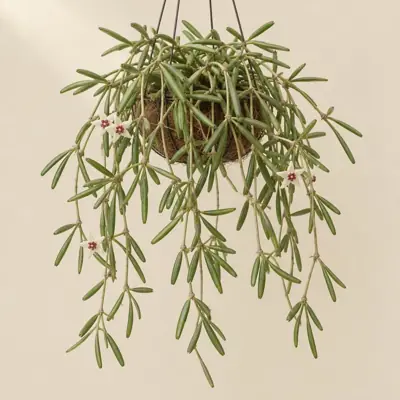
Hoya retusa is an evergreen perennial with an epiphytic, climbing or trailing vine-like habit, forming clumps of long, pendent stems.
Watch: 21 Hoyas: Water Less, Wait Longer
Overview
Hoya retusa is an evergreen perennial with an epiphytic, climbing or trailing vine-like habit, forming clumps of long, pendent stems.
Origin and habitat
Sources differ on its native range, which is described as India and the eastern Himalayas. It is epiphytic and is recorded from cooler lowland forests in Assam, India, with adaptation to mountain environments. It favors tropical to subtropical environments, but its adaptation to mountain environments allows it to tolerate cooler conditions; frost should be avoided.
Characteristics
A single source reports a mature height of about 60.96–152.4 cm; sources are few. Sources differ in their descriptions of the green, narrow to linear, grass-like, succulent leaves, which are clustered near the nodes with leafless internodes; the leaves may have purple spots, a longitudinal groove underneath, and a notched tip. The fragrant, sometimes faintly scented, star-shaped flowers have white, creamy white to off-white petals and a red, pink to deep-purple central corona, occurring singly or in small clusters. It is reported to flower in summer.
Light
It is reported to prefer partial shade to bright light, accepting dappled shade or morning sun but not prolonged full direct sun.
Watering
Moderate watering is reported to suit it: use a well-drained medium, allow it to dry moderately between waterings, and avoid prolonged wetness or standing water; reduce watering in cooler months, while epiphytic cultivation may use lighter, frequent misting or soaking to supply water.
Temperature and dormancy
Sources differ on the minimum temperature, with limited evidence placing it at about 1.7 °C. Sources differ on the reported USDA hardiness classification. Hoya retusa is frost tender; keep above freezing.
Growing medium and mounting
A light, well-drained potting medium rich in organic matter is generally recommended, while prolonged wet, sticky conditions should be avoided.
Feeding
A balanced fertilizer is reported to be suitable during active growth.
Propagation
Hoya retusa can be propagated by stem cuttings; sources indicate that cuttings root readily in spring and summer and can be transplanted after the medium is initially kept moist.
Common problems
Aphids, spider mites, and mealybugs are reported as potential pests. Excessively wet growing medium or excessive water retained in the container is reported to cause root rot, and the plant does not tolerate persistently wet potting medium. It is sensitive to frost, and container-grown plants in cold regions need frost protection and additional protection.
Identification
Hoya retusa is distinguished by narrow, grass-like succulent leaves with conspicuously notched tips, a trailing habit, and white star-shaped flowers with a red to purple central corona.
Photos

