
Hoya obovata (Hoya obovata)
Hoya obovata is an epiphytic, creeping to climbing and twining vine. It is reported to be an evergreen perennial.
Watch: 21 Hoyas: Water Less, Wait Longer
Overview
Hoya obovata is an epiphytic, creeping to climbing and twining vine. It is reported to be an evergreen perennial.
Origin and habitat
Sources differ on its native range: records include India, Indochina and Sulawesi in Indonesia, while other accounts record the Moluccas or Fiji. It grows as an epiphyte in relatively open sites and along forest edges, where it can extensively cover the trunks and branches of host trees. It occurs in tropical to subtropical environments and does not tolerate frost.
Characteristics
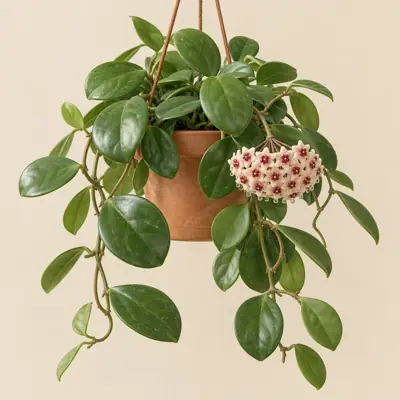
Sources differ on growth rate; it is described as slow to moderate, tending to be slow under ordinary container-growing conditions, with green-leaved forms growing faster than variegated forms. The leaves are thick, fleshy, leathery and hairless, ranging from obovate and nearly round to obcordate or heart-shaped; the tips may be distinctly notched, the margins are recurved, and some plants have silver spots on dark green leaves. Sources differ in descriptions of the flowers; the inflorescences are flat umbels, with corollas ranging from creamy white and yellow-orange to pink and coronas generally from purplish red to dark red, while the petal lobes curve backward and the flowers can produce nectar and have a distinct, rose-like fragrance. It is reported to flower continuously from late spring through autumn, and its fruit is reported to be a hairless follicle.
Light
Bright indirect light, filtered light or partial shade is suitable, including afternoon shade; prolonged strong direct light may cause sunburn, while stronger light may give the leaves a bronze coloration and encourage flowering.
Watering
Water regularly during the growing season without overwatering, allowing the growing medium to dry between waterings; keep it drier with good airflow in winter, as prolonged wetness can damage the roots.
Humidity and airflow
It is reported to need good airflow.
Temperature and dormancy
A specialist source reports a minimum temperature of about 10 °C; sources are few. It is generally frost tender; keep above freezing.
Growing medium and mounting
Use a well-drained, loose and porous growing medium that still retains some moisture; cited examples include chopped coconut husk or orchid growing medium.
Feeding
A specialist source recommends feeding during the growing season with fertilizer higher in potassium and phosphorus and lower in nitrogen, and also reports that fertilizer may be applied in summer.
Propagation
It can be propagated from stem cuttings, which may flower even while the resulting plant is still small.
Common problems
It is reported to be susceptible to aphids, spider mites and mealybugs. Prolonged wetness in the growing medium can cause root rot, while overwatering or persistently wet potting medium can damage roots; excess moisture combined with shade may also produce swollen, untidy growth, and prolonged strong direct light may cause sunburn. It does not tolerate frost and needs protection in cold weather; it can tolerate hot outdoor weather when paired with strongly filtered light rather than prolonged direct sunlight.
Identification
Hoya obovata has large, very thick leaves ranging from nearly round to obcordate, often with a notched tip, and some leaves have silver spots. It resembles Hoya kerrii, but sources distinguish Hoya obovata by its larger flowers and coronas, slightly different leaf shape and usual lack of hairs.
Photos

