
Hoya multiflora (Hoya multiflora)
Sources describe Hoya multiflora differently: it is an evergreen tropical epiphyte that may form a compact upright or obliquely growing shrub, or grow as a climber or vine. It is reported to be evergreen.
Watch: 21 Hoyas: Water Less, Wait Longer
Overview
Sources describe Hoya multiflora differently: it is an evergreen tropical epiphyte that may form a compact upright or obliquely growing shrub, or grow as a climber or vine. It is reported to be evergreen.
Origin and habitat
Hoya multiflora is native from South Asia through Southeast Asia and the Malay Archipelago, including Assam in India, Bangladesh, Myanmar, Thailand, southern China, with Yunnan specifically noted by a Chinese-language source, Indochina, Malaysia, Indonesia including Java and Sulawesi, and the Philippines. It is reported to grow as a forest epiphyte on shrubs and trees in more open settings as well as in primary, secondary, and planted forests. It is a tropical plant that favors warm conditions with some humidity and does not tolerate low temperatures well.
Characteristics
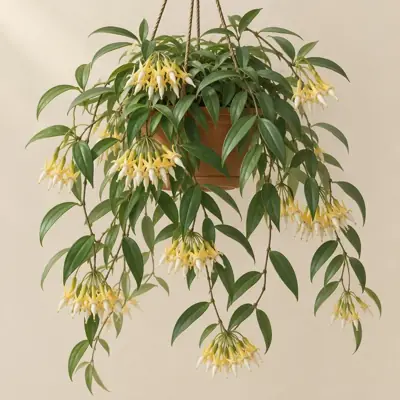
Sources differ on mature size, giving a range of about 30–250 cm. Under suitable conditions it is reported to grow well and vigorously as a compact shrubby species; its leaves are oblong to oblong-lanceolate, pointed at the tip, usually narrowing or wedge-shaped at the base, hairless, thick, tough and nearly leathery, glossy green to dark green, with white spotting on some plants. Sources differ in their descriptions of the clustered, waxy, fragrant flowers, which range from white or cream to straw yellow, with some orange-yellow coloration; the strongly reflexed corolla lobes and prominent white corona give each flower a rocket- or shooting-star-like form, and sources also differ on flowering time, describing flowering mainly from spring to late summer or autumn, while some report flowering throughout the year and possible repeat flowering from the peduncle. The fruit is reported to consist of paired, slender, linear-lanceolate follicles containing seeds with tufts that allow wind dispersal, with fruiting reported in autumn.
Light
Hoya multiflora is generally suited to partial sun or partial shade with bright, indirect light, while strong sunlight may scorch the leaves.
Watering
During active growth, water regularly and moderately in a medium that retains some moisture while draining well; the surface or medium can be allowed to dry slightly before watering again, while prolonged wetness and waterlogging should be avoided, and excessive dryness may cause flowers to fade prematurely.
Humidity and airflow
Hoya multiflora is reported to prefer high humidity.
Temperature and dormancy
Sources differ on its hardiness-zone description. Few sources report temperature limits, with a range of about 10–40 °C. It is generally frost tender; keep above freezing.
Growing medium and mounting
A well-drained, loose, porous medium that still retains some moisture is suitable and allows air to reach the epiphytic roots; examples given by sources include peat, fibrous media, sand with perlite, pumice or expanded clay, chopped coconut husk, and orchid medium.
Feeding
During the growing season, it is reported to benefit from regular feeding with fertilizer suitable for epiphytes; a source also recommends a formulation higher in potassium and phosphorus and lower in nitrogen.
Propagation
Hoya species are generally reported to be propagated by stem cuttings.
Common problems
Hoya species are reported to be susceptible to aphids, spider mites, and mealybugs, while prolonged overly wet potting medium may cause root rot. Prolonged direct strong light can scorch leaves, excessive dryness may cause flowers to fade prematurely, and persistently wet potting medium can damage roots; excessive moisture and shade may produce soft, unruly growth, while moving the plant as buds develop may cause bud drop. It does not tolerate low temperatures or frost; freezing and cold conditions should be avoided in winter, and container plants in colder climates are best moved indoors for protection.
Identification
The most conspicuous features are clusters of white and yellow flowers with strongly reflexed corolla lobes and a prominent, pointed corona, giving each flower a shooting-star- or rocket-like outline.
Photos


Sources
- Wikipedia (en): Hoya multiflora — CC BY-SA 4.0 · link
- 維基百科:流星毬蘭 — CC BY-SA 4.0 · link
- Wikipedia (nl): Hoya multiflora — CC BY-SA 4.0 · link
- LLIFLE Encyclopedia of living forms: Hoya multiflora — CC BY-SA · link
- NC State Plant Toolbox: Hoya (genus-level) — copyright (facts only) · link
- Top Tropicals catalog: Hoya multiflora — © Top Tropicals LLC (facts only) · link