
Hoya lacunosa (Hoya lacunosa)
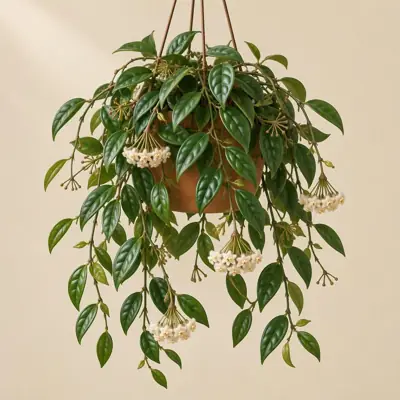
Hoya lacunosa is a small, vining epiphyte that may creep, climb, or trail, and may also grow as a lithophyte; its slender stems can root and attach at the nodes.
Watch: 21 Hoyas: Water Less, Wait Longer
Overview
Hoya lacunosa is a small, vining epiphyte that may creep, climb, or trail, and may also grow as a lithophyte; its slender stems can root and attach at the nodes.
Origin and habitat
Sources differ on its native range: they support tropical Asia, including Thailand, Malaysia, and Indonesia, including Borneo, Java, and Sumatra, while some also report India, China, Singapore, the Philippines, and southern Myanmar. It occurs in epiphytic habitats in tropical forests, including forest edges, more open areas, and secondary forest, growing attached to tree trunks and branches; it may also grow as a lithophyte. Its climate is that of warm, humid tropical forests.
Characteristics
Sources differ in their descriptions of the leaves; they are opposite, small, ovate to lanceolate, fleshy, leathery, and glossy, with rounded to cuneate bases, pointed tips, and surfaces that may be depressed or pitted between the veins. The flowers are borne in pendent umbels and are white to creamy white or pale yellow, star-shaped, and hairy, with strongly reflexed corolla lobes and a yellowish central corona; they have a pronounced fragrance often described as cinnamon-like and especially strong at night. Under suitable conditions, it is reported to flower repeatedly and may bloom multiple times throughout the year; it is also reported to grow well and vigorously under suitable conditions while maintaining a relatively compact form. The fruit is a slender, spindle-shaped to lanceolate follicle.
Light
Hoya lacunosa grows in bright, indirect light to partial shade, while another source describes partial shade to shade; strong direct sunlight should be avoided because it can scorch the leaves.
Watering
Keep the growing medium moderately moist but well drained, allowing it to dry slightly between waterings; avoid prolonged excessive moisture to reduce the risk of root rot.
Humidity and airflow
Hoya lacunosa prefers high humidity. A single source reports a humidity range of about 50–70 %.
Temperature and dormancy
Sources differ on its USDA hardiness-zone classification. It is generally reported to be frost tender and should be kept above freezing.
Growing medium and mounting
Use a moist but well-drained orchid-type growing medium; a mixture containing perlite, pine bark, sand, and peat may be used, with an emphasis on a loose structure, drainage, and root aeration.
Propagation
Hoya lacunosa is reported to be propagated by stem cuttings.
Common problems
It is generally reported to have no major pest problems, but mealybugs and spider mites should be watched for. Overwatering is reported to cause root rot, and fungal diseases including powdery mildew and leaf spot may also occur. Overwatering can lead to root rot, strong direct light can scorch the leaves, and insufficient light may produce weak growth with elongated internodes. It prefers warm conditions and higher humidity, while strong direct sunlight readily causes leaf scorch.
Identification
Hoya lacunosa is distinguished by small, fleshy leaves with depressed or pitted texture between the veins, small densely clustered white to creamy-white hairy flowers with yellow centers and a pronounced fragrance, and a compact, trailing habit.
Photos


Sources
- Wikipedia (en): Hoya lacunosa — CC BY-SA 4.0 · link
- 維基百科:裂瓣球兰 — CC BY-SA 4.0 · link
- Wikipedia (de): Hoya lacunosa — CC BY-SA 4.0 · link
- Wikipedia (fr): Hoya lacunosa — CC BY-SA 4.0 · link
- NC State Plant Toolbox: Hoya lacunosa — copyright (facts only) · link
- Wikipedia (nl): Hoya lacunosa — CC BY-SA 4.0 · link
- LLIFLE Encyclopedia of living forms: Hoya lacunosa — CC BY-SA · link
- Top Tropicals catalog: Hoya lacunosa — © Top Tropicals LLC (facts only) · link