
Heart Hoya (Hoya kerrii)
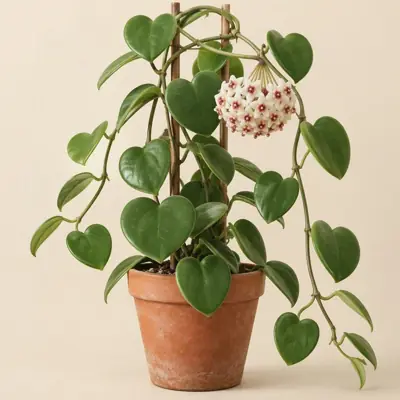
Hoya kerrii is an evergreen, perennial, climbing or trailing herbaceous vine that can grow as an epiphyte.
Watch: 21 Hoyas: Water Less, Wait Longer
Overview
Hoya kerrii is an evergreen, perennial, climbing or trailing herbaceous vine that can grow as an epiphyte.
Origin and habitat
Sources differ on its native range: it occurs mainly from Southeast Asia to southern China, including Thailand, Laos, Cambodia, Vietnam, and Java in Indonesia, while some sources also include the Malay Peninsula. It can grow in dry forest, deciduous broadleaf forest, and remnant limestone scrub, climbing trunks and branches and growing in small amounts of substrate or humus on trees while producing aerial roots. It is adapted to warm tropical to subtropical conditions and favors warmth, relatively high atmospheric humidity, and protection from frost.
Characteristics
Sources differ, placing mature height at about 300–400 cm. A single source reports a mature spread of about 10–50 cm, so sources are few. Growth-rate descriptions differ, ranging from slow to fast, with one source also reporting substantial annual vine extension once vining begins. The opposite leaves are thick and fleshy to leathery, obcordate or nearly rounded-heart-shaped with a conspicuous central notch at the tip, dark green above and paler beneath; the small star-shaped flowers occur in nearly spherical to convex clusters, usually with cream-white or white corollas and pink to purplish-red coronas, and can secrete abundant reddish-brown nectar; flowering is reported in summer.
Light
Bright, indirect light is suitable, with some shade tolerated; some sources list full sun, while RHS recommends avoiding hot, intense direct sunlight.
Watering
Water moderately during the growing period in a well-drained medium, allowing it to dry slightly between waterings; in winter, keep it only slightly moist.
Humidity and airflow
It is reported to prefer high humidity.
Temperature and dormancy
A single source gives a minimum temperature of about 12.5 °C, so sources are few. Sources differ in the hardiness ratings they assign. It is generally frost tender; keep above freezing.
Growing medium and mounting
A single source reports that a fast-draining, peat-free loam-based medium with added organic matter can be used, and lists loamy or sandy soils across acidic, neutral, or alkaline conditions as suitable.
Feeding
A single source reports using a balanced liquid fertilizer regularly during the growing period.
Propagation
It can be propagated by layering in spring or summer, by semi-ripe cuttings with bottom heat in late summer, or by cuttings more generally; a single rooted heart-shaped leaf without stem tissue usually does not readily develop into a complete plant.
Common problems
Aphids, spider mites, and mealybugs may occur, while disease is generally uncommon, though waterlogging or overwatering can cause root rot. A single source reports that overwatering may cause root rot and inhibit flowering, while abundant reddish-brown nectar from the flowers may drip and stain fabric, walls, or furniture. It favors warm, sheltered conditions, and low temperatures can slow growth and flowering; sources also recommend maintaining a warm minimum during overwintering.
Identification
Its most conspicuous feature is its thick, fleshy, heart-shaped leaves with a central notch; it is a climbing vine capable of substantial elongation rather than merely a plant consisting of a single heart-shaped leaf.
Photos


Sources
- Wikipedia (en): Hoya kerrii — CC BY-SA 4.0 · link
- Wikipedia (ja): ホヤ・カーリー — CC BY-SA 4.0 · link
- Wikipedia (de): Hoya kerrii — CC BY-SA 4.0 · link
- Wikipedia (fr): Hoya kerrii — CC BY-SA 4.0 · link
- NC State Plant Toolbox: Hoya kerrii — copyright (facts only) · link
- Wikipedia (ko): 호야 케리 — CC BY-SA 4.0 · link
- LLIFLE Encyclopedia of living forms: Hoya kerrii — CC BY-SA · link
- RHS Plants: Hoya kerrii — © RHS, facts only · link
- Top Tropicals catalog: Hoya kerrii — © Top Tropicals LLC (facts only) · link