
Hoya curtisii (Hoya curtisii)
Hoya curtisii is a small, vining perennial herb that can climb, creep, or trail and may grow as an epiphyte or on rocks.
Watch: 21 Hoyas: Water Less, Wait Longer
Overview
Hoya curtisii is a small, vining perennial herb that can climb, creep, or trail and may grow as an epiphyte or on rocks.
Origin and habitat
Hoya curtisii is native to Southeast Asia, including Thailand, Malaysia and the Malay Peninsula, Borneo, and the Philippines. It grows as an epiphyte or on rocks and may creep or climb. It is reported from humid tropical environments.
Characteristics
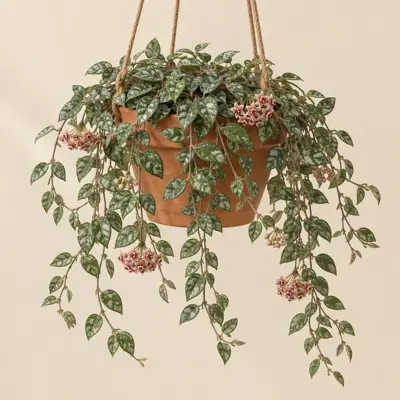
A single source reports a mature height of about 5.08–7.62 cm and a mature spread of about 30.48–91.44 cm; sources are few for these measurements. It is reported to grow slowly. The opposite, simple leaves are small and fleshy to slightly succulent, dark green with silver or green-silver markings; sources differ in describing their shape as nearly round, elliptical, ovate, or somewhat spatulate, and the leaves may have a distinct pointed tip. The fragrant, star-shaped flowers occur in clusters; sources differ in describing the corolla and corona colors, including pink or red with a white center, or dark yellow, greenish yellow to yellow-brown corollas with a creamy-white corona and red center, and one source reports flowering in summer while noting that timing may vary with growing conditions.
Light
Bright indirect light is generally recommended, while strong direct sunlight that can scorch the leaves should be avoided; it is also reported to tolerate partial shade.
Watering
It is reported to tolerate drought but to be sensitive to overwatering; water thoroughly, then allow the growing medium to dry somewhat before watering again, while maintaining good drainage.
Humidity and airflow
One source reports humidity of about 50–60 %; sources are few for this range.
Temperature and dormancy
A single source reports a hardiness-zone range for Hoya curtisii.
Growing medium and mounting
A single source recommends an organic-rich, well-drained potting medium with a slightly acidic preference, with perlite or vermiculite added to improve aeration and drainage.
Propagation
Hoya curtisii is reported to be propagated by stem cuttings.
Common problems
Reported pests include aphids, spider mites, scale insects, and mealybugs, while root rot is a reported disease problem. Overwatering or poor drainage is reported to cause root rot, and the plant is sensitive to excessively wet conditions. Strong direct sunlight may scorch the leaves.
Identification
Within Hoya, Hoya curtisii can be recognized by its small, pointed leaves with silver markings and its fine creeping or trailing vines.
Photos


