
porcelainflower (Hoya carnosa)
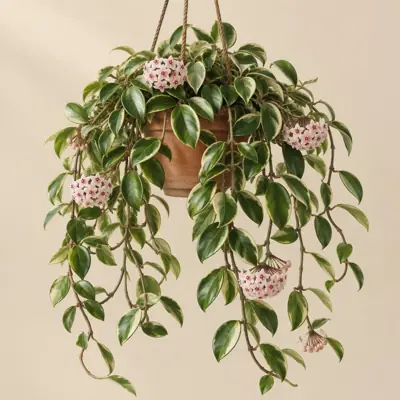
Hoya carnosa is an evergreen perennial vine that can climb and twine or grow as a trailing plant, and it can be grown as an epiphyte or in hanging containers.
Watch: 21 Hoyas: Water Less, Wait Longer
Overview
Hoya carnosa is an evergreen perennial vine that can climb and twine or grow as a trailing plant, and it can be grown as an epiphyte or in hanging containers.
Origin and habitat
Sources differ on its native range, describing it broadly from eastern Asia through Southeast Asia to Australia, with more detailed accounts including India, southern China, Japan, Taiwan, Queensland, and Fiji; Taiwan's species list regards it as native to Taiwan. It can grow as an epiphyte on trees and also occurs on rocks, coastal rocky ground, limestone terrain, and in forests; stems can root at the nodes and climb tree trunks or rock surfaces. It favors warm conditions and is suited to warm environments with high or moderate humidity; horticultural cultivation generally requires protection from frost.
Characteristics
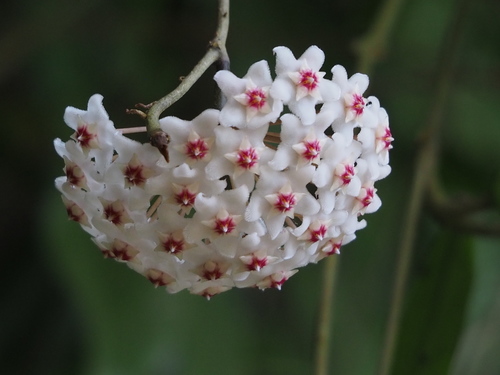
Few sources report a mature height of about 400–800 cm and a spread of about 100–150 cm. Sources differ in their descriptions of the leaves, which are opposite, thick and fleshy, leathery to somewhat succulent, and waxy and glossy, with shapes ranging from elliptical, broadly ovate, and ovate-oblong to nearly heart-shaped. Sources differ in their descriptions of the flowers and flowering season: the flowers are waxy, star-shaped, white to pale pink, often with a red or deep-pink central corona, and densely clustered in umbel-like inflorescences; they are generally sweetly fragrant, especially at night, and can secrete sweet, sticky nectar, with flowering mainly from spring through summer and in some accounts continuing into late summer. The fruit is an elongated, spindle-shaped follicle containing seeds with abundant silky hairs, and the plant is reported to grow vigorously.
Light
Sources differ on light requirements, recommending bright indirect or filtered strong light and, in some accounts, partial sun or partial shade, while another source lists full sun.
Watering
Use a well-drained medium and let it dry somewhat after watering before watering again, avoiding prolonged wetness; during the resting period, the medium can approach dryness before more water is given.
Humidity and airflow
Hoya carnosa prefers high humidity.
Temperature and dormancy
Few sources report an ideal temperature of about 16–24 °C and a minimum of about 5 °C. It is frost tender; keep above freezing. It is described using USDA and RHS hardiness classifications.
Growing medium and mounting
Use a loose, organic-rich, fast-draining growing medium; suitable soil types are described as loam, sandy, or chalky, with acidic, neutral, or alkaline conditions all included.
Feeding
Fertilizer can be applied periodically during the growing season, with sources recommending either recurring feeding in spring and summer or a slow-release fertilizer applied periodically.
Propagation
Hoya carnosa can be propagated by stem or semi-hardwood cuttings or by layering, and cuttings can be rooted in growing medium or water.
Common problems
Possible pests include mealybugs, while another source also lists indoor fungus gnats and banded greenhouse thrips. Disease problems are generally reported to be uncommon. Either overly wet or overly dry medium can cause leaf drop; excessive wetness can also cause root rot, while strong sun exposure can yellow the leaves. It is sensitive to frost and freezing; outdoor cultivation should use a sheltered, frost-free setting and avoid dry, strong winds.
Identification
Hoya carnosa is distinguished by thick, waxy, glossy leaves, twining or trailing vine stems, and clusters of waxy, star-shaped, fragrant flowers; its flower stalks are perennial structures that can flower repeatedly from the same position over multiple years.
Photos



Sources
- Wikipedia (en): Hoya carnosa — CC BY-SA 4.0 · link
- 維基百科:球兰 — CC BY-SA 4.0 · link
- Wikipedia (ja): サクララン — CC BY-SA 4.0 · link
- Wikipedia (de): Hoya carnosa — CC BY-SA 4.0 · link
- Wikipedia (fr): Hoya carnosa — CC BY-SA 4.0 · link
- Wikipedia (es): Hoya carnosa — CC BY-SA 4.0 · link
- NC State Plant Toolbox: Hoya carnosa — copyright (facts only) · link
- Wikipedia (it): Hoya carnosa — CC BY-SA 4.0 · link
- Wikipedia (nl): Grote wasbloem — CC BY-SA 4.0 · link
- Wikipedia (pt): Hoya carnosa — CC BY-SA 4.0 · link
- Wikipedia (ko): 호야 카르노사 — CC BY-SA 4.0 · link
- TaiCOL 臺灣物種名錄: Hoya carnosa — CC BY 4.0 · link
- 農業知識入口網 植物圖鑑: Hoya carnosa — © MOA, facts only · link
- RHS Plants: Hoya carnosa — © RHS, facts only · link