
Kentia Palm (Howea forsteriana)
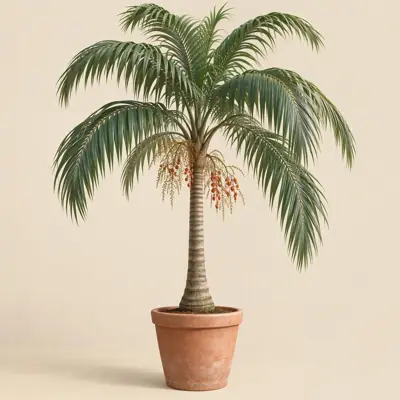
Howea forsteriana is a perennial evergreen palm with a single trunk, naturally growing as a solitary tree.
Overview
Howea forsteriana is a perennial evergreen palm with a single trunk, naturally growing as a solitary tree.
Origin and habitat
Howea forsteriana is endemic to Lord Howe Island, Australia. It occurs in lowland and coastal environments on Lord Howe Island, especially favoring the calcareous sandstone substrate common in the lowlands, and is more associated with coastal and low-elevation habitats than Howea belmoreana. Outdoors it favors tropical climates but can also grow in cooler regions with mild winters, and it is widely cultivated in tropical and subtropical regions.
Characteristics
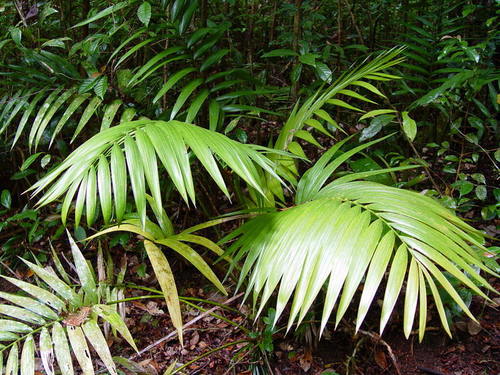
Sources differ on mature height, placing it at about 800–1800 cm, while mature spread is 400–600 cm. It is reported to grow relatively slowly; sources describe its foliage somewhat differently, but describe large, dark green, pinnate leaves with an arching rachis and soft, drooping, narrowly lanceolate leaflets. The small flowers are borne on drooping inflorescences below or among the leaves, and the inflorescences may branch; male flowering generally precedes female flowering, although flowering can be synchronous on volcanic substrates, and pollination is mainly by wind. Sources differ in their descriptions of the fruit and seed development; the fruit is described as elliptical to ovoid and orange or red when ripe, with seeds taking a prolonged period to mature.
Light
Sources differ in their light guidance: indoors it tolerates low to moderate light, while guidance also recommends partial shade or bright conditions away from direct sunlight, with young plants especially protected from strong direct light.
Watering
Water moderately and regularly during the growing period, keeping the growing medium moderately moist but well drained and avoiding waterlogging; reduce watering in winter.
Humidity and airflow
It is generally reported to prefer moderate humidity and need little air movement.
Temperature and dormancy
Sources differ on the lower temperature limit, with limited evidence suggesting about -5 °C; limited evidence also reports an upper temperature of about 38 °C. It is generally reported to have a warm-climate hardiness classification.
Growing medium and mounting
Use a well-drained, humus-rich growing medium; guidance recommends a loam-based, peat-free medium that may include composted bark and leaf mold, with acidic to neutral conditions.
Feeding
Apply small amounts of houseplant fertilizer; coated slow-release fertilizer may be used, and guidance recommends monthly liquid feeding in summer.
Propagation
Propagate by seed; guidance recommends warm sowing conditions, and germination may be uneven.
Common problems
Possible pests include mealybugs, root mealybugs, thrips, glasshouse thrips, scale insects, and glasshouse red spider mites. Sources differ on disease problems: sooty mold is listed by one source, while another reports that the plant generally has few disease problems. Waterlogged growing medium is reported to potentially cause fungal problems; strong direct sunlight may scorch young plants, and leaves rubbing against walls or curtains may damage their tips. It prefers sheltered conditions and a warm climate, while mature plants can tolerate light frost only briefly and generally should not be exposed to low temperatures.
Identification
Howea forsteriana has a single slender trunk with ringed leaf scars, along with large pinnate leaves whose arching rachis and soft, drooping leaflets create a distinctly drooping, arched habit.
Photos



Sources
- Wikipedia (en): Howea forsteriana — CC BY-SA 4.0 · link
- Wikipedia (de): Forstersche Kentia — CC BY-SA 4.0 · link
- Wikipedia (fr): Kentia — CC BY-SA 4.0 · link
- Wikipedia (es): Howea forsteriana — CC BY-SA 4.0 · link
- GBIF descriptions: Lista de especies de plantas exóticas y trasplantadas de Colombia; Catálogo de Plantas y Líquenes de — per dataset · link
- NC State Plant Toolbox: Howea forsteriana — copyright (facts only) · link
- RHS Plants: Howea forsteriana — © RHS, facts only · link