
Hippeastrum hybrid (Hippeastrum hybrid)
Hippeastrum hybridum is reported to be a perennial herbaceous bulbous plant.
Overview
Hippeastrum hybridum is reported to be a perennial herbaceous bulbous plant.
Origin and habitat
The genus Hippeastrum is reported to be native to tropical and subtropical parts of the Americas, from Mexico south to Argentina and some Caribbean islands; another source summarizes its range as Central and South America. The genus is reported to occur in varied habitats, including forest understories, full-sun sites, floodplains, and drier environments, and some species are epiphytes. Native species are reported to occur mainly in tropical and subtropical climates, while some at higher southern latitudes or higher elevations may occur in temperate environments.
Characteristics
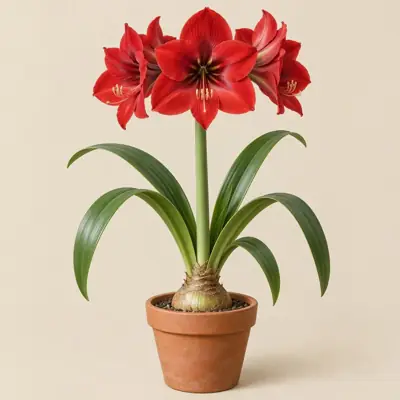
With few source data, mature height is reported to be about 30.48–91.44 cm and mature spread about 0–30.48 cm. The leaves are reported to be long, strap-shaped, smooth, and green; within the genus they may be evergreen or deciduous. Large, conspicuous flowers are reported to form an umbel at the top of an upright, hollow flower stalk, with colored tepals and stamens; horticultural forms include red, pink, white, orange, salmon, and bicolored flowers, as well as single, double, and miniature forms. Sources differ on flowering timing: cultivation conditions can alter it, with indoor bulbs reported to flower in winter and plants started indoors in spring flowering from late spring into early summer; after fertilization, capsule fruits containing flat brown or black seeds are reported to form.
Light
It is reported to grow in full sun to partial sun, and a bright position is recommended when growth is restarted indoors.
Watering
It is generally watered sparingly after planting until leaves and flower buds appear, then kept moderately moist during active growth without overwatering; watering is reduced during dormancy and may be withheld for a period as part of dormant management.
Temperature and dormancy
It is reported to be frost tender; keep above freezing. Sources differ on the reported hardiness and on conditions under which plants can overwinter outdoors.
Growing medium and mounting
A rich, organic, moist but well-drained growing medium is reported to be suitable, including a well-drained organic mix for containers. Sources differ on planting depth, but report that the bulb should not be completely buried and that the neck or part of the bulb should remain above the surface.
Feeding
A general fertilizer containing iron and magnesium is reported to be suitable, with light feeding during summer growth to support formation of flower buds for the following year.
Propagation
Propagation is reported to be possible by division or seed, and examples within the genus also include vegetative propagation using offsets formed around the parent bulb.
Common problems
Reported pests include mealybugs, thrips, mites, aphids, slugs, snails, narcissus bulb flies, other bulb flies, and, outdoors, grasshoppers. Infection by Stagonospora curtisii is reported to cause red blotch and other red lesion symptoms. Overwatering is reported to cause bulb and root rot, while mealybugs, snails, and slugs are also concerns. The bulbs are reported to be frost sensitive and susceptible to cold damage at low temperatures; plants are generally grown indoors in containers in cold regions and may be grown outdoors in warmer regions.
Identification
Hippeastrum hybridum is reported to have a large bulb and long, strap-shaped leaves, with a stout, upright, hollow, leafless flower stalk bearing a large terminal umbel whose developing buds are enclosed by bracts before opening.