
rose of Sharon (Hibiscus syriacus)
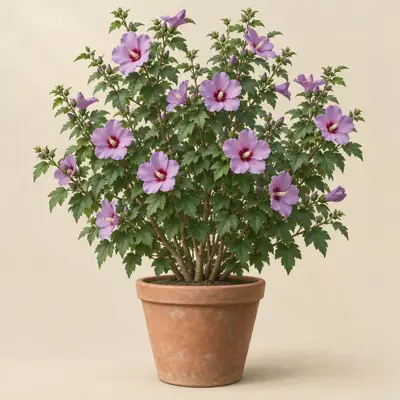
Hibiscus syriacus is an upright, vase-shaped to shrubby deciduous shrub that may also take the form of a small tree. It is a perennial deciduous woody plant.
Overview
Hibiscus syriacus is an upright, vase-shaped to shrubby deciduous shrub that may also take the form of a small tree. It is a perennial deciduous woody plant.
Origin and habitat
Sources differ on its native range: it is described as native to Asia, mainly East Asia, with several accounts pointing more specifically to China and some including Taiwan or southern China. It occurs on sea cliffs, hillsides, along streams, and roadsides, and is also widely cultivated in gardens, parks, streets, and other human-modified environments. It can be cultivated from tropical to temperate regions, prefers warm conditions with abundant sunlight, and has considerable cold tolerance.
Characteristics
Sources differ on mature size, with height reported at about 250–400 cm; the few sources for spread report about 250–400 cm. Sources differ in describing its growth rate as moderate to fast. The alternate, green to yellow-green leaves are usually ovate to ovate-rhombic, often shallowly lobed with coarse serrations; they are deciduous and emerge relatively late in spring. Sources differ in their descriptions of the flowers and flowering period: the large funnel- to bell-shaped flowers may be single, semi-double, or double, occur in white, pink, red, purple, pale purple, or blue, sometimes have a contrasting center, and have a prominently projecting staminal column; individual flowers are short-lived, while flowering continues mainly from summer into autumn. One source reports capsules that split when mature to expose or disperse seeds, with some fruit persisting on branches through winter, while many modern horticultural cultivars may not produce fruit.
Light
Sources differ somewhat on light: full sun is considered best, while some accept partial sun, though abundant sunlight is preferred for better flowering.
Watering
Moist but well-drained soil is best; established plants tolerate some drought, but prolonged poor drainage should be avoided, and water supply can be increased in summer and before flowering.
Temperature and dormancy
Sources differ on minimum temperature, with a reported value of about -20 °C. The few available sources report an ideal temperature of about 15–28 °C and a maximum of about 41 °C. One source reports a hardiness range spanning several USDA zones. Hibiscus syriacus is frost hardy.
Growing medium and mounting
Sources differ in some details, but Hibiscus syriacus prefers fertile, humus-rich, moist but well-drained soil and can adapt to varied soil types and pH conditions, including acidic to neutral conditions.
Feeding
Fertile soil rich in organic matter is suitable, and increased fertilization and nitrogen supply can improve foliage density and quality.
Propagation
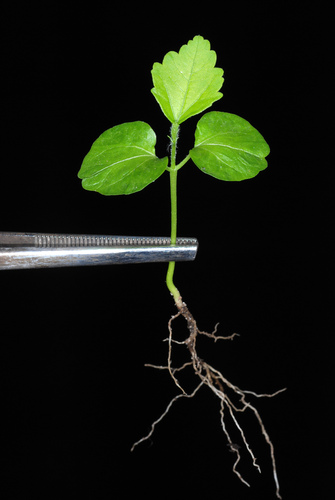
Hibiscus syriacus can be propagated by seed, cuttings, or layering, with horticultural sources also recommending semi-hardwood cuttings; seedlings may differ in their traits from the parent plant.
Common problems
Potential pests include aphids, scale insects, mealybugs, greenhouse whiteflies, and Japanese beetles; Japanese beetles can severely damage foliage when uncontrolled. Possible diseases include leaf spot, wilt, rust, canker, and powdery mildew; older plants may develop severe trunk dieback, and honey fungus is also reported as an uncommon problem. In suitable environments it may self-seed extensively and become naturalized, with mild to pronounced invasive tendencies in some regions, while excessively poor drainage is also unsuitable for growth. Mature plants tolerate heat, some drought, humid conditions, and frost and have considerable cold tolerance, though cultivation still favors warm, sheltered, well-drained conditions.
Identification
Hibiscus syriacus is an upright deciduous shrub, often with coarsely serrated lobed leaves and large funnel-shaped flowers with a prominent central staminal column; the flowers are short-lived but open successively from summer into autumn.
Photos


Sources
- Wikipedia (en): Hibiscus syriacus — CC BY-SA 4.0 · link
- 維基百科:木槿 — CC BY-SA 4.0 · link
- Wikipedia (ja): ムクゲ — CC BY-SA 4.0 · link
- Wikipedia (de): Straucheibisch — CC BY-SA 4.0 · link
- Wikipedia (fr): Hibiscus syriacus — CC BY-SA 4.0 · link
- Wikipedia (es): Hibiscus syriacus — CC BY-SA 4.0 · link
- GBIF descriptions: Manual of the Alien Plants of Belgium; Checklist of introduced taxa in Cyprus; Checklist of introduc — per dataset · link
- NC State Plant Toolbox: Hibiscus syriacus — copyright (facts only) · link
- Wikipedia (it): Hibiscus syriacus — CC BY-SA 4.0 · link
- Wikipedia (nl): Althaeastruik — CC BY-SA 4.0 · link
- Wikipedia (ko): 무궁화 — CC BY-SA 4.0 · link
- Useful Tropical/Temperate Plants: Hibiscus syriacus — CC BY-NC-SA 3.0 (facts only) · link
- RHS Plants: Hibiscus syriacus — © RHS, facts only · link
- USDA PLANTS Database: Hibiscus syriacus — Public domain (US Government work) · link