
redflower false yucca (Hesperaloe parviflora)
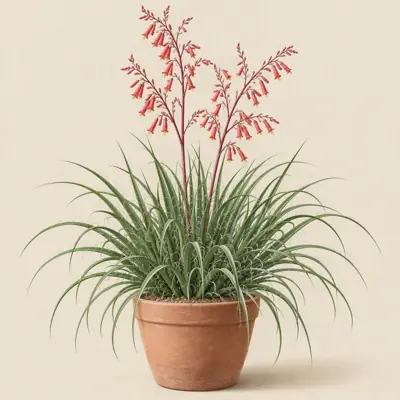
Hesperaloe parviflora is a stemless, clumping, rosette-forming evergreen semi-succulent perennial with a yucca-like, grassy or fountain-like habit.
Overview
Hesperaloe parviflora is a stemless, clumping, rosette-forming evergreen semi-succulent perennial with a yucca-like, grassy or fountain-like habit.
Origin and habitat
It is native to North America, ranging from Texas in the United States to northeastern Mexico, especially Coahuila. Its native habitats include dry desert and scrub environments, including the Chihuahuan Desert, and it is also recorded from the Edwards Plateau in Texas. It is adapted to hot, dry climates with strong sunlight and tolerates heat and drought, with some cold tolerance.
Characteristics
Sources differ on mature size, placing height at about 60–150 cm and spread at about 90–120 cm; growth is generally reported to be slow to moderate. The evergreen leaves are narrow, linear to narrowly lance-shaped, arching, leathery and flexible, green to blue-green, with curled white to gray-white threadlike fibers along the margins; the plant stores water in its leaves. The pendent flowers are tubular to elongated bell-shaped, usually pink, coral-red, salmon-red or bright red, often with yellow inside or at the tips; yellow, cream or white cultivated forms also occur, and the flowers are borne on tall inflorescences that are often branched in their upper portion; sources differ on flowering period, describing it mainly from late spring through summer, sometimes extending into autumn or, in warm-winter areas, nearly throughout the year. After pollination it forms woody capsules that mature from pale green to brown and are ovoid to elongated-ovoid or nearly round, with black seeds.
Light
Hesperaloe parviflora takes full sun; when grown indoors, it requires bright light.
Watering
It is drought tolerant and should not remain wet for long periods; water after the soil dries, provide moderate water during the growing season, and reduce watering in winter.
Temperature and dormancy
Sources are few and differ on the minimum temperature, with about -5 °C reported; the plant is frost hardy. Sources differ on its hardiness classification. It rests in winter. It tolerates heat and is adapted to hot desert conditions, although another source reports that it does not favor extreme summer heat.
Growing medium and mounting
It requires well-drained soil and can grow in sandy soil, loam, caliche and limestone soils; RHS recommends infertile to moderately fertile, exceptionally well-drained neutral to acidic sand or loam. It needs a fast-draining mix and is prone to rot.
Feeding
It has low fertilizer needs; low-nitrogen fertilizer can be applied monthly during the growing period.
Propagation
It is reported to be propagated by seed or by separating offsets in spring. Separating offsets is also reported as a propagation method.
Common problems
Potential pests include scale insects and aphids, and deer may also browse the plant. Wet, heavy, poorly drained soil may lead to fungal root rot, although RHS describes the plant as generally having few diseases. The main cultivation problem is root rot associated with excessive moisture and poor drainage, with excess moisture especially problematic in winter. Although heat and drought tolerant, it can be sensitive to severe frost and excessive winter moisture in cold conditions, and the risk of root rot rises when high humidity accompanies frost.
Identification
Hesperaloe parviflora forms dense clumps of narrow, arching leaves with conspicuous white threadlike fibers along their margins, together with tall, branched inflorescences bearing reddish tubular flowers; its overall appearance resembles a yucca, but its leaves are more flexible.
Photos


Sources
- Wikipedia (en): Hesperaloe parviflora — CC BY-SA 4.0 · link
- Wikipedia (de): Hesperaloe parviflora — CC BY-SA 4.0 · link
- Wikipedia (fr): Hesperaloe parviflora — CC BY-SA 4.0 · link
- NC State Plant Toolbox: Hesperaloe parviflora — copyright (facts only) · link
- LLIFLE Encyclopedia of living forms: Hesperaloe parviflora — CC BY-SA · link
- RHS Plants: Hesperaloe parviflora — © RHS, facts only · link
- USDA PLANTS Database: Hesperaloe parviflora — Public domain (US Government work) · link
- Top Tropicals catalog: Hesperaloe parviflora — © Top Tropicals LLC (facts only) · link
- Hesperaloe parviflora | Giromagi cactus and succulents for sale | Buy plants onl (www.giromagi.com) — facts only (§12) · link