
Hawaiian-elf (Heptapleurum arboricola)
Heptapleurum arboricola is an evergreen perennial woody plant that grows as a shrub or small tree, may grow independently or on other tree trunks, and is commonly grown indoors as a potted foliage tree.
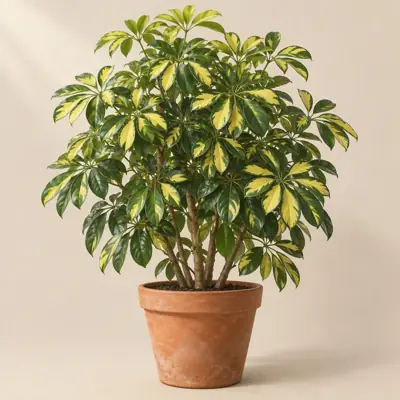
Overview
Heptapleurum arboricola is an evergreen perennial woody plant that grows as a shrub or small tree, may grow independently or on other tree trunks, and is commonly grown indoors as a potted foliage tree.
Origin and habitat
Sources differ on its native range; it is described as native to Taiwan and southern parts of China including Hainan, and Taiwan's species list treats it as native to Taiwan. It is associated with tropical to subtropical environments where severe frost is a concern, and its RHS hardiness rating is H1C.
Characteristics
Sources differ and are few on mature size, giving about 122–183 cm in height and about 122–183 cm in spread. The palmately compound leaves have glossy, leathery leaflets that range from obovate and oblong to elliptic; cultivated plants often have smaller leaflets, while 'Gold Capella' has yellow or golden and green variegation. Small bisexual flowers are densely grouped into small umbels arranged in compound panicles; sources differ on flower color, and flowering occurs from around midsummer to early autumn but is rare indoors. The small, nearly spherical to ovoid drupes are orange when immature; sources differ on their mature color, and birds or other animals may eat them and aid dispersal.
Light
Provide bright, indirect light to partial shade; indoors it can be placed at an east-, south-, or west-facing exposure with strong light filtered, and although it adapts to different light levels, intense direct indoor light may scorch the leaves.
Watering
Keep a well-drained growing medium moderately moist, allowing the soil to dry somewhat before watering thoroughly and avoiding prolonged waterlogging; water moderately during the growing period and reduce watering in winter.
Temperature and dormancy
A single source reports a minimum temperature of about 15.6 °C; sources are few. It is generally reported to have an RHS hardiness rating of H1C.
Growing medium and mounting
Use a well-drained indoor plant growing mix that may be loamy or sandy and is preferably rich in organic matter; the plant can adapt to acidic, neutral, or alkaline pH.
Feeding
It is generally recommended to apply a balanced liquid fertilizer monthly during the growing period.
Propagation
It can be propagated from seed, semi-ripe cuttings, other cuttings, or air layering, and cuttings can root in soil or water.
Common problems
Potential pests include spider mites, mealybugs, scale insects, and greenhouse thrips. Serious disease problems are generally absent, but prolonged waterlogging can cause root rot. A growing medium that is either too wet or too dry can cause leaf drop, while waterlogging can cause root rot and intense direct indoor light can scorch leaves. As a tropical plant with relatively low cold tolerance, it is unsuitable for severe frost; NC State advises against outdoor placement when temperatures fall below a certain level.
Identification
The most conspicuous feature of 'Gold Capella' is its yellow or golden and green variegation on palmately compound leaves, while the species typically has leaves composed of several glossy leaflets.
Sources
- Wikipedia (en): Heptapleurum arboricola — CC BY-SA 4.0 · link
- GBIF descriptions: Especies introducidas, exóticas, trasplantadas, invasoras y potencialmente invasoras obtenidas a par — per dataset · link
- NC State Plant Toolbox: Heptapleurum arboricola — copyright (facts only) · link
- TaiCOL 臺灣物種名錄: Heptapleurum arboricola — CC BY 4.0 · link
- RHS Plants: Heptapleurum arboricola — © RHS, facts only · link